

When a marriage comes to an end, one of the questions many people ask is whether they can continue using their married surname. In the United Kingdom, keeping your married name after divorce is a personal decision that is fully recognised in law. Some choose to keep it for the sake of their children, others because it has become part of their professional identity, and some simply prefer it to their maiden name. Whatever the reason, the law allows complete freedom to make that choice. This article explains what keeping your married name after divorce in the UK means in law, what your rights are, and what it means for your identification and everyday life.
Article highlights:
- Understand what keeping your married name after divorce in the UK means legally
- Learn about your rights under British law to continue using your married surname
- Find out how keeping your married name affects your passport, financial records, and other documents
- Discover how different regions of the UK interpret surname use after divorce
- Compare the UK’s legal position with that of Australia and the United States
Keeping Your Married Name After Divorce in the UK
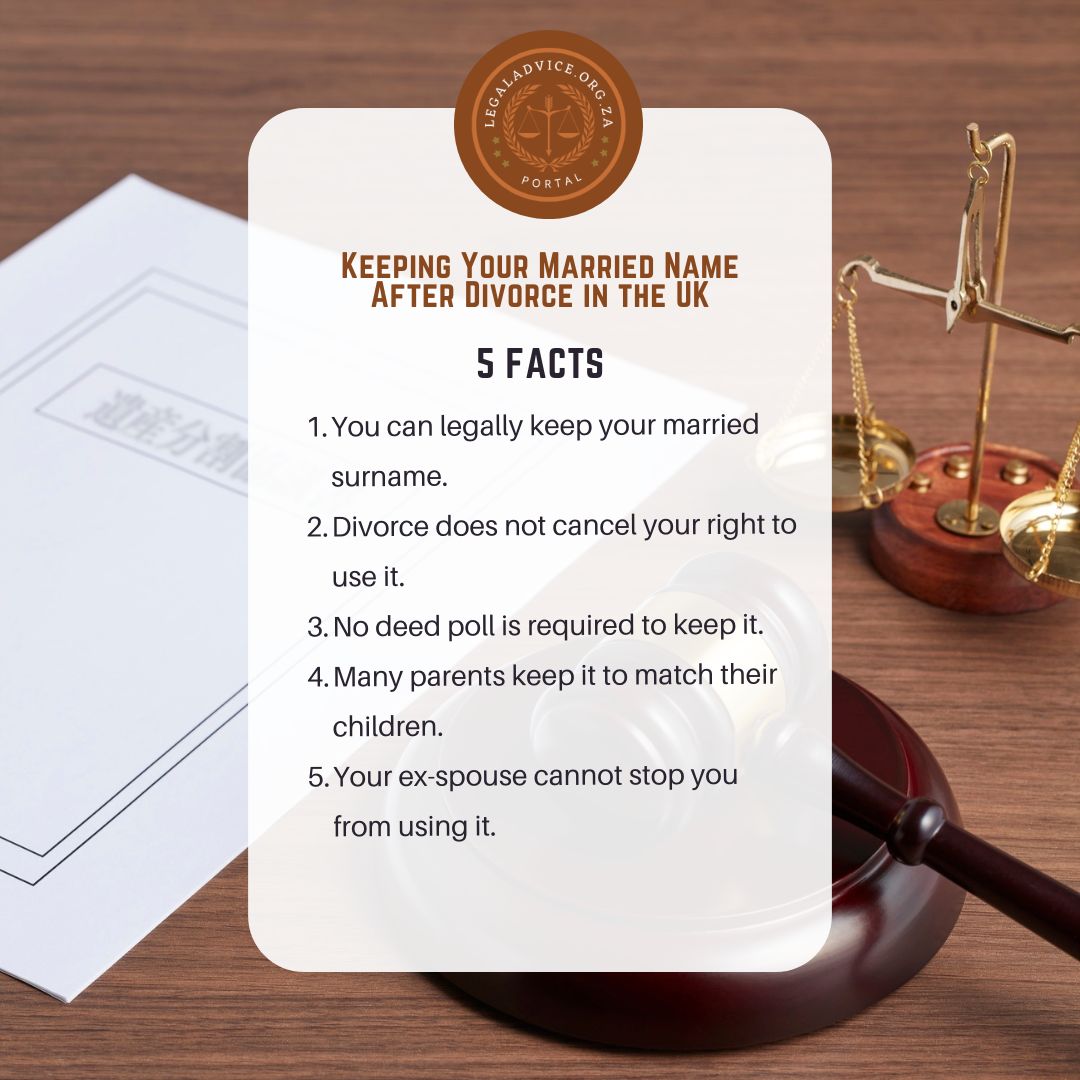
Keeping your married name after divorce in the UK is entirely lawful. Once you take your spouse’s surname through marriage, it becomes your legal name, and divorce does not change that automatically. You are not legally required to revert to your maiden name or adopt any new name unless you wish to. In other words, your married surname remains your legal identity until you actively decide to change it.
This legal right applies equally to both men and women. Whether your marriage lasted two years or twenty, you are free to keep the surname you used during the marriage without needing permission from your former spouse or any court.
The first step to take is to understand your legal standing
Under UK law, there is no obligation to change your name after divorce. The name you used during your marriage remains valid, and you can continue to use it across all aspects of life, including work, travel, and finance. The divorce certificate, known as the decree absolute or final order, simply ends the marriage but does not alter your name.
If you decide to keep your married name, there is no need to apply for a new deed poll, court order, or registration. You can continue using the name on all your legal and official documents. However, if you later wish to change your surname, you will need to present the relevant documents such as your marriage certificate, divorce decree, or a deed poll as proof of identity.
The second step to take is to decide whether to update your documents
Keeping your married name after divorce in the UK means that you are not required to update your identification unless your personal details change. Your passport, driving licence, and bank accounts can continue to carry your married surname until they expire. When renewing them, you simply apply under the same name.
However, if your marital status changes and you wish to reflect that while keeping your surname, you can update your passport or other documents to show that you are divorced without changing your name. This is useful if you want your paperwork to be factually accurate while maintaining continuity in your identity.
The third step to take is to consider the practical implications
Keeping your married name after divorce in the UK can have personal and social implications. For many people, it is the name their children carry, which helps maintain a sense of unity in family life. It can also prevent confusion in school or healthcare records where children and parents share the same surname.
Professionally, many people continue using their married name to maintain consistency in business, career, or academic records. For example, if you have published work, built a professional brand, or established recognition under your married name, keeping it can avoid complications.
There are no legal downsides to continuing to use your married surname, but you should ensure consistency across all records. Using different names in different contexts can lead to confusion in banking, taxation, or travel.
The fourth step to take is to understand consent and personal boundaries
In the UK, keeping your married name after divorce does not require your former spouse’s consent. The name you used during marriage becomes part of your legal identity, and you retain full rights to continue using it after the marriage ends. Your ex-partner cannot force you to give it up, even if they have remarried or would prefer that you stop using it.
However, you must ensure that your continued use of the name is not misleading or fraudulent. For example, you should not use your married surname to access joint accounts or sign legal documents on behalf of your former spouse. As long as you use the name honestly, it remains your lawful identity.
How keeping your married name after divorce is treated across the UK
The right to keep your married surname after divorce applies across England, Scotland, Wales, and Northern Ireland, though each region has small differences in interpretation.
In England and Wales, once you take your spouse’s surname through marriage, it becomes your legal name. You can keep it indefinitely unless you decide to change it.
In Scotland, marriage does not automatically change your legal name. Even if you use your spouse’s surname socially, your maiden name remains your official legal name. This means you can use either name after divorce, depending on which one you prefer.
In Northern Ireland, the same principles apply as in England and Wales. You can continue using your married surname without any formal action, and it remains legally valid for all purposes.
Comparison with other countries
In Australia, the rules are similar to those in the UK. Once you marry and take your spouse’s surname, it becomes your legal name. After divorce, you can continue using it freely unless you decide to revert to your maiden name. The government does not require any special process to retain your married name.
In the United States, the situation varies by state. Most states allow you to keep your married name after divorce without restrictions, while others include a name change option within the divorce decree. Unless you request a change, your married name remains valid.
These comparisons show that the UK’s approach is one of the most flexible internationally, giving individuals full autonomy over their post-divorce identity.
Summary of key points about keeping your married name after divorce in the UK
| Step | Action | Legal Effect |
|---|---|---|
| 1 | Understand your legal standing | Married surname remains valid |
| 2 | Decide whether to update documents | Updates optional, not required |
| 3 | Consider social and professional reasons | Can keep for children or work |
| 4 | Recognise consent and legal rights | No need for ex-partner’s permission |
Final thoughts on keeping your married name after divorce in the UK
Keeping your married name after divorce in the UK is entirely lawful and often practical. The law respects your right to maintain the name you have built your identity around, whether for family, professional, or personal reasons. Once adopted, your married surname remains your legal name until you decide otherwise. What matters most is ensuring that your choice reflects your identity and that all your records remain accurate and consistent.