

When a marriage ends, one of the personal choices a person must make is whether to keep or change their surname. In the United Kingdom, many people decide to keep their married name after divorce, either for practical, emotional, or family reasons. This decision can carry both legal and social implications, but the good news is that the law gives complete freedom of choice. This guide explains your legal rights when keeping your last name after divorce in the UK, what it means for your identification and family matters, and how this practice compares with other countries.
Article highlights:
- Understand your legal right to keep your last name after divorce in the UK
- Learn how keeping your surname affects passports, bank records, and official documents
- Discover the social and professional reasons many people retain their married name
- Compare how name rights after divorce differ across regions of the UK
- See how other countries, such as Australia and the United States, approach the same issue
Keeping Your Last Name After Divorce in the UK
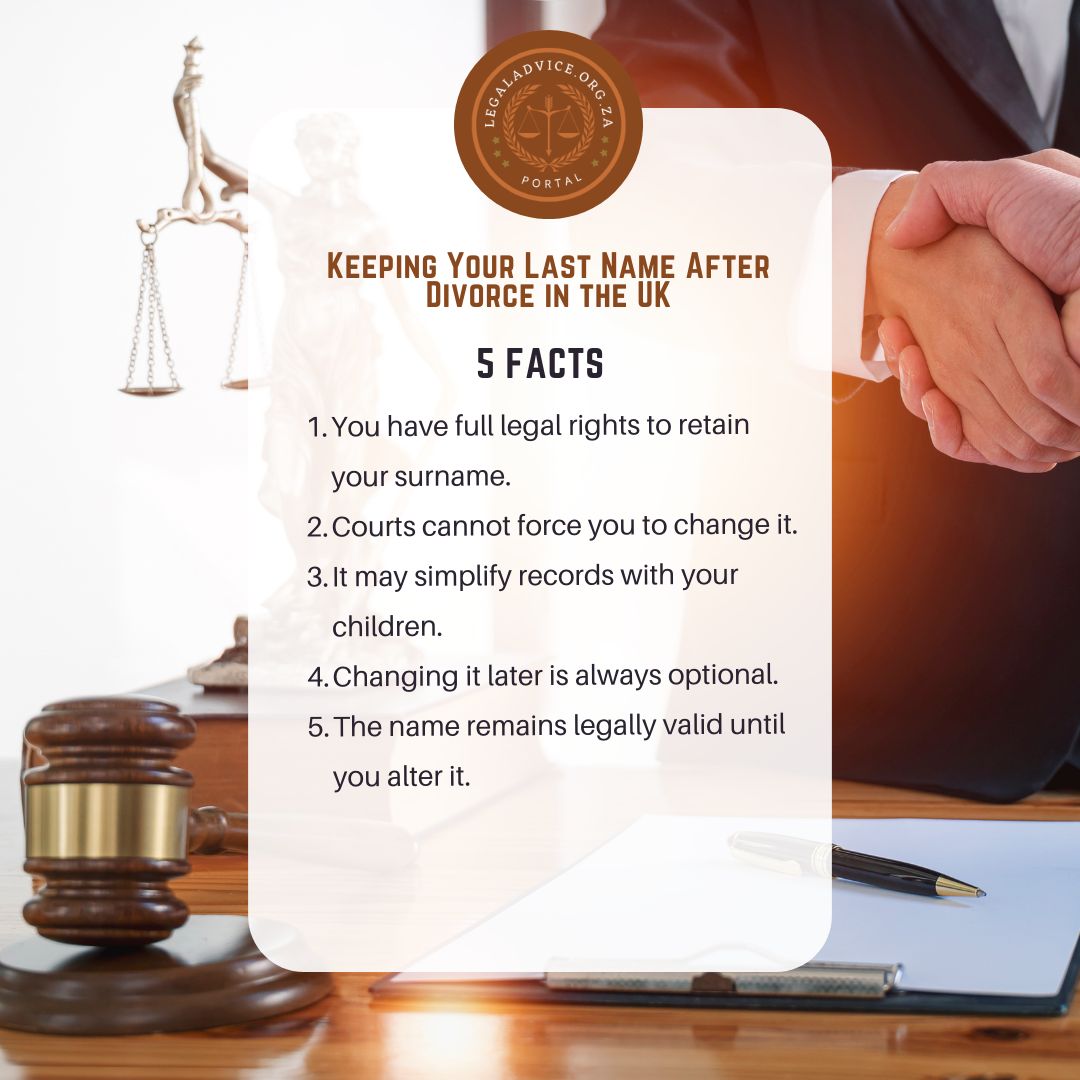
Keeping your last name after divorce in the UK is a personal decision that the law fully supports. When a divorce is finalised, you are not required to change your name, nor does the court automatically revert it to your maiden name. You can continue using your married surname legally for as long as you wish. This includes using it on your passport, driving licence, bank accounts, and all other documents.
The UK has no law that restricts which surname you use after divorce, as long as it is not used to commit fraud or mislead others. Many divorced individuals, especially those with children, prefer to keep their married surname to maintain consistency within the family or because they have used it professionally for years.
The first step to take is to confirm your right to keep your surname
When you keep your last name after divorce in the UK, you do not need any new legal documentation. The surname you adopted during marriage remains your legal name unless you decide to change it. Your decree absolute or final order does not affect your surname. You can continue to use your married name exactly as before without notifying any authority.
However, if you decide later to revert to your maiden name or adopt a new one, you must provide proof of the change, usually through your decree absolute, marriage certificate, or a deed poll.
The second step to take is to decide whether to update your official records
If you choose to keep your last name after divorce in the UK, you do not have to change any of your official documents. You can continue using your passport, driving licence, and other records in your married name until they expire. When you renew them, simply fill in your existing surname in the same way.
However, if you wish to update your marital status, you can do so separately without changing your name. For example, your passport can still show your married surname while reflecting that your marital status is divorced. This is a practical approach for those who wish to maintain continuity while reflecting their new circumstances.
The third step to take is to consider the personal and social implications
Keeping your last name after divorce in the UK can have social and emotional advantages. Many parents choose to keep the same surname as their children to avoid confusion at school or when travelling abroad. Others may keep it for professional reasons if they have built a reputation under that name.
At the same time, it is important to consider potential complications. Using your married surname may occasionally cause administrative confusion, especially if your ex-spouse remarries and their new partner also adopts that surname. However, these situations are rare, and legally you are entitled to continue using the name without restriction.
In personal settings, some people also use both names during the transition period, such as their maiden name in social life and their married name for work or official matters. This is legally permissible as long as there is no intent to deceive.
The fourth step to take is to communicate your decision clearly
Once you decide to keep your last name after divorce in the UK, it is a good idea to inform key organisations that you are divorced but will continue using your married name. This ensures all your records stay consistent. You can notify your employer, your bank, and government departments like HMRC and the DVLA.
If you travel frequently, keeping the same name on your passport, tickets, and travel documents will help avoid problems at border control. Consistency is essential across all forms of identification, so choose one name and apply it universally.
Legal differences across regions of the UK
The law on keeping your last name after divorce is the same across the United Kingdom, but small administrative variations exist between regions.
In England and Wales, once you marry and adopt your spouse’s surname, it becomes your legal name. After divorce, you can continue using it indefinitely unless you take action to change it.
In Scotland, marriage does not legally change your name. Even if you use your spouse’s surname socially, your maiden name remains your legal one. This means that after divorce, you can use either name without needing legal proof.
In Northern Ireland, you can continue using your married name after divorce without restriction, following the same principles as England and Wales.
Comparison with other countries
In Australia, keeping your last name after divorce is also allowed. Your married name remains valid until you formally revert to your maiden name. The government does not require you to notify anyone unless you wish to update your official documents.
In the United States, the rules vary by state, but in most places, the divorce decree includes an option to restore your maiden name. If you do not choose that option, you can continue using your married surname legally.
Compared to these systems, the UK provides one of the simplest and most flexible frameworks, allowing individuals complete freedom in how they identify after divorce.
Summary of key legal points for keeping your last name after divorce in the UK
| Step | Action | Legal Requirement |
|---|---|---|
| 1 | Confirm your right to keep your married name | No new documentation required |
| 2 | Continue using your name on all records | Optional updates only |
| 3 | Inform key institutions of your marital status | Recommended for consistency |
| 4 | Keep documents consistent when travelling | Prevents identity issues |
Final thoughts on keeping your last name after divorce in the UK
Keeping your last name after divorce in the UK is a legally valid and entirely personal choice. You are under no obligation to change your name, and no court or institution can force you to do so. For many people, the decision reflects a balance between personal identity, family unity, and professional continuity. As long as your records are consistent and used honestly, the name you choose remains fully protected under UK law.