

After divorce, many people in the United Kingdom decide to return to their maiden name as part of moving forward. The process can carry both legal and social implications, especially if you have been known by your married name for several years. While the law in the UK gives you full freedom to choose which name to use, it is important to understand the proper legal steps, as well as how the decision can affect everyday matters such as work, family, and identification. This article explains the legal position on using your maiden name after divorce in the UK and explores the social and practical aspects of doing so.
Article highlights:
- Learn what the law says about using your maiden name after divorce in the UK
- Understand when you need legal proof such as a decree absolute or deed poll
- Explore the social and practical effects of returning to your maiden name
- See how name-use rules differ across England, Scotland, Wales, and Northern Ireland
- Compare how similar cases are handled in Australia and the United States
Using Your Maiden Name After Divorce in the UK
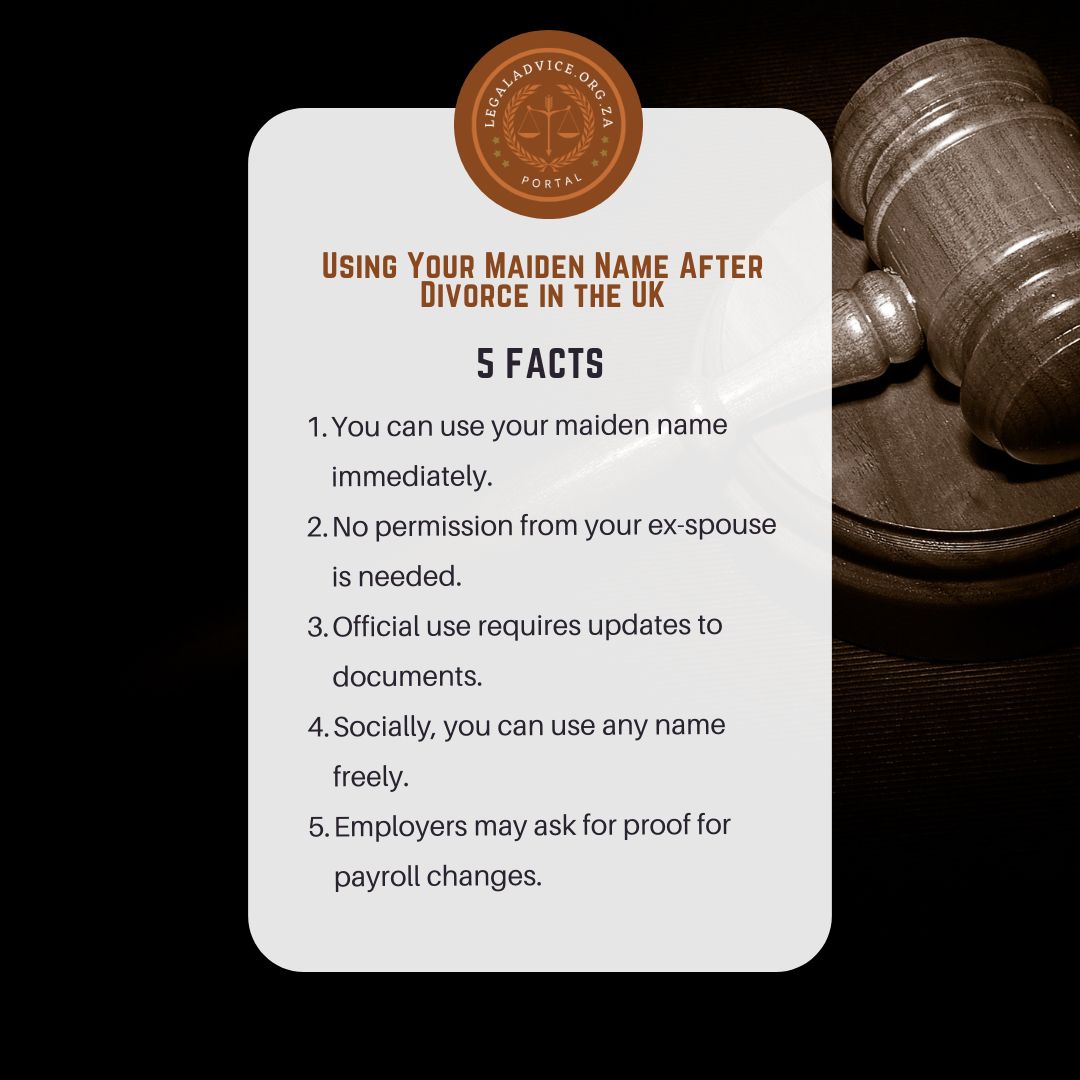
Using your maiden name after divorce in the UK is entirely your choice. The law does not require you to keep your married name, nor does it automatically revert your name after divorce. You are legally free to start using your maiden name again at any time, but you must ensure that official documents reflect your chosen name. Most government departments and financial institutions will need proof of the name you intend to use, usually through your decree absolute, marriage certificate, or deed poll.
The first step to take is to confirm your legal proof of name use
Before you start using your maiden name after divorce in the UK, you must have legal documentation that supports the change. The two main documents used are your decree absolute and your marriage certificate. The decree absolute proves that your marriage has legally ended, while the marriage certificate shows the link between your maiden name and your married name.
If both documents are available and clearly show your maiden name, you can use them to update your passport, bank accounts, and other official records. However, if your decree absolute does not include your maiden name, some organisations may ask for a deed poll to formally confirm your change.
The second step to take is to decide whether to update your documents
Legally, you can use your maiden name without changing every document immediately, but for practical purposes, consistency is important. When using your maiden name after divorce in the UK, you should consider updating your main forms of identification first, such as your passport, driving licence, and bank accounts.
Other organisations, such as HMRC, your employer, and utility companies, will need to be informed to ensure that your financial and tax records remain accurate. Keeping both names active at the same time can cause confusion in credit applications or medical records, so it is best to ensure that all your key documents match.
The third step to take is to consider the social and professional effects
Using your maiden name after divorce in the UK can also have social implications. Some people find it empowering, while others keep their married name for reasons related to their children, career, or reputation. If you have built a professional name under your married surname, you may wish to keep it for work while using your maiden name in personal matters.
There is no legal restriction on using both names, as long as you are not using them to mislead anyone. For example, you can keep your married name for work but revert to your maiden name for official documents such as your passport.
If you share children with your former spouse, you can also use your married name when dealing with schools or health services to avoid confusion, even if your legal documents reflect your maiden name.
The fourth step to take is to understand when a deed poll becomes necessary
If your decree absolute and marriage certificate are not enough to prove your name change, or if you want to use a completely different surname, a deed poll will be required. A deed poll is a legal declaration confirming your decision to stop using one name and start using another. It is recognised by all UK government departments, banks, and employers.
There are two types of deed poll:
- Unenrolled deed poll – A simple document signed and witnessed privately.
- Enrolled deed poll – Officially recorded with the Royal Courts of Justice, making it part of the public record.
Most people find that an unenrolled deed poll is sufficient for personal use. Once you have it, you can update your records across all institutions.
Legal and regional differences across the UK
The legal right to use your maiden name after divorce applies throughout the United Kingdom, but how the process is handled varies slightly between regions.
In England and Wales, your married name becomes your legal name during the marriage, so you must provide proof to revert to your maiden name. The combination of a decree absolute and marriage certificate usually suffices.
In Scotland, your maiden name remains your legal name even after marriage. This means you can begin using it again at any time without formal paperwork, though you may need to show your divorce documents when updating records.
In Northern Ireland, the same process applies as in England and Wales, but some organisations may be stricter about documentation, particularly banks and financial services.
Comparison with other countries
In Australia, women can use their maiden name again after divorce by presenting their marriage and divorce certificates. However, some states require registration of the name change through the Registry of Births, Deaths and Marriages, particularly if a new passport is required.
In the United States, the process varies by state. Some states allow the judge to include a name restoration clause within the divorce decree, while others require a separate name change application after the divorce is finalised.
Compared to these systems, the UK approach is more flexible, as it allows individuals to use their maiden name freely without applying for a court order, provided they can prove their identity and marital history.
Key considerations for using your maiden name after divorce in the UK
| Step | Action | Document Required |
|---|---|---|
| 1 | Confirm legal proof of name change | Decree absolute and marriage certificate |
| 2 | Update personal and financial records | Passport, driving licence, HMRC, banks |
| 3 | Evaluate social and professional impact | Personal decision |
| 4 | Apply for a deed poll if required | Deed poll certificate |
Final thoughts on using your maiden name after divorce in the UK
Using your maiden name after divorce in the UK is both a legal right and a personal decision. The law allows you to resume your original name without restriction, but you must ensure your documents and records reflect that choice consistently. Whether you return to your maiden name for personal, emotional, or professional reasons, what matters most is that your identity feels authentic to you. Taking time to complete the process properly ensures clarity in both legal and social settings, allowing you to move forward with confidence.