

When a marriage ends, one of the first questions many people ask is whether divorce changes their name automatically in the UK. For most, keeping or changing a married name after divorce is an emotional decision. Some prefer to move on by reverting to their maiden name, while others keep their married surname for professional or family reasons. However, the law in the United Kingdom is clear: divorce alone does not automatically change your name. You must take formal steps if you wish to change it legally on your records.
Article highlights:
- Find out if your name changes automatically after a UK divorce
- Learn when and how to use your decree absolute as proof of name change
- Discover why a deed poll may still be required
- See how the process differs across England, Scotland, Wales, and Northern Ireland
- Compare how name changes after divorce work in countries like Australia and the United States
Does Divorce Change Your Name Automatically in the UK
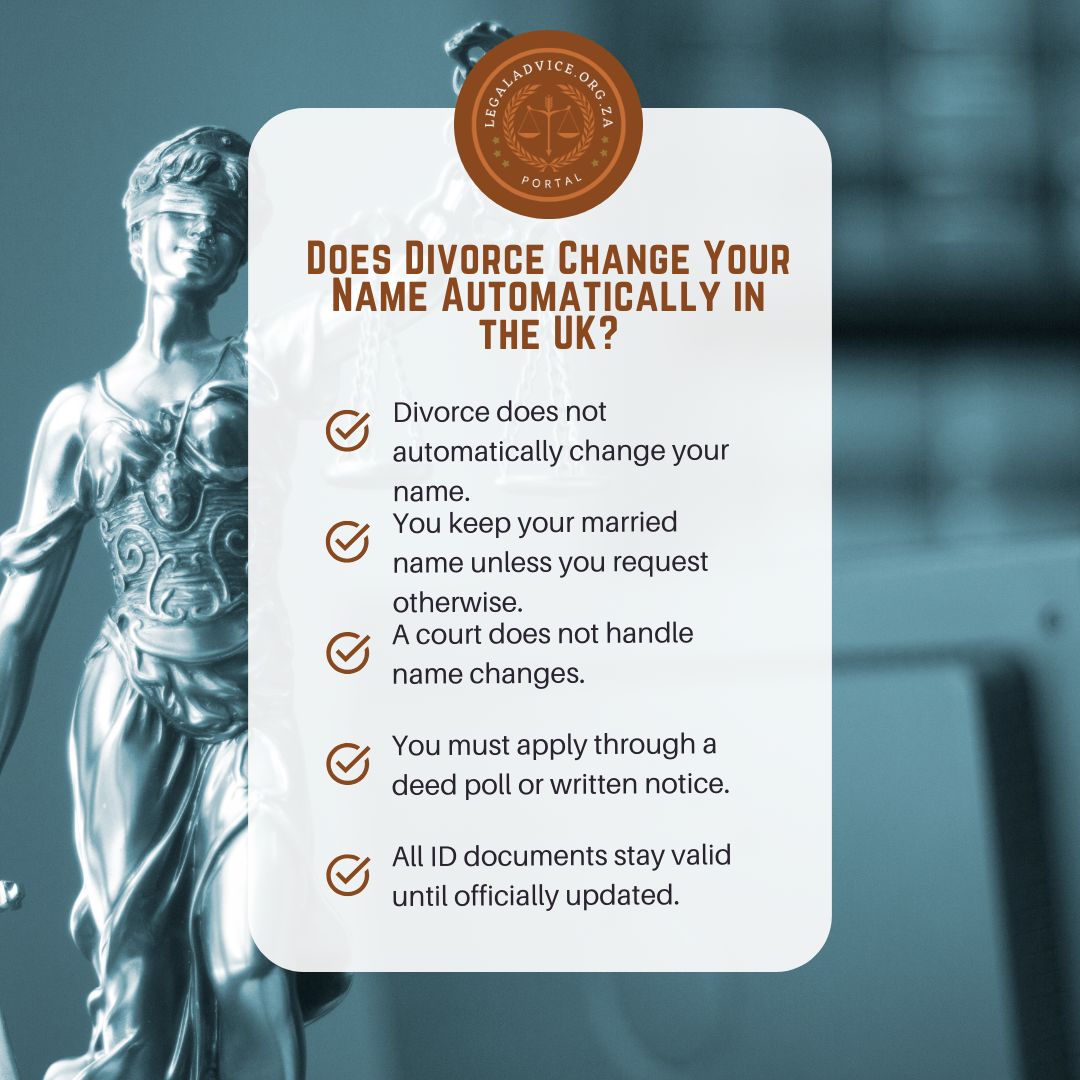
Divorce does not change your name automatically in the UK. When your marriage legally ends through a decree absolute or final order, your legal name remains exactly as it appears on your official records. The law does not reverse your name back to your maiden name, even if that is what you used before marriage. This means that if you wish to stop using your married name, you must take deliberate legal action to do so.
In the UK, a person’s name is a matter of record, not marital status. Once you adopt a new name through marriage, it becomes your legal identity until you actively change it again. Therefore, even though your marriage ends, your married surname remains valid in law until you provide evidence of a change.
The first step to take is to check your decree absolute or final order
Your decree absolute (or final order in no-fault divorces) is the official document confirming that your divorce is legally complete. Check whether this document includes your maiden name. If it does, it can serve as proof that you wish to revert to that name.
However, in most cases, the decree absolute does not include your previous name. This means you will need additional proof, such as your original marriage certificate and your birth certificate, to show your identity before and after marriage. Some institutions may accept these documents as sufficient evidence to restore your maiden name, but others will not.
The second step to take is to decide whether you need a deed poll
If your decree absolute is not enough for certain organisations, you will need to apply for a deed poll. A deed poll is a legal document that shows you have chosen to stop using your married name and are now using a new or previous name.
There are two types of deed poll in the UK:
- Unenrolled deed poll – This is the simplest option and can be prepared privately or through an online provider.
- Enrolled deed poll – This version is registered with the Royal Courts of Justice and becomes part of the public record.
The unenrolled option is accepted by most UK bodies such as the DVLA, banks, and HM Passport Office. You will only need an enrolled deed poll if a specific institution or legal body requires it for formal verification.
The third step to take is to update your records and documents
Once you have legal proof of your name change, you must update your personal and official documents. Start with those that affect your daily life:
- Passport
- Driving licence
- Bank accounts and credit cards
- HMRC and National Insurance records
- GP and medical records
- Utility providers and insurance companies
It is recommended to start with your passport and driving licence, as these are primary identification documents in the UK. Use your decree absolute or deed poll when submitting name change requests. Keeping all updated documents consistent avoids future complications when applying for travel visas, employment checks, or financial services.
The fourth step to take is to notify employers and other institutions
Your employer, pension fund, and any professional or educational bodies must also be informed about your name change. Provide a copy of your legal documentation so payroll, tax, and qualification records can be corrected.
If you have children, you are allowed to continue using your married name for school-related matters to avoid confusion, even if you legally return to your maiden name. The UK recognises that parents may use different surnames for personal or practical reasons as long as there is no intention to mislead.
How the process varies across different parts of the UK
The procedure for changing your name after divorce is largely the same across the United Kingdom, but there are small variations in how it is handled administratively.
In England and Wales, your married name is legally recognised during the marriage, and the divorce does not alter it automatically. You must use a decree absolute or deed poll to revert to your maiden name.
In Scotland, you never legally lose your maiden name when you marry, as your married name is considered a social use name rather than a legal one. Therefore, reverting to your birth name after divorce is simpler.
In Northern Ireland, the approach is similar to England and Wales, with most institutions accepting your decree absolute as proof, though some banks or government bodies may still require a deed poll.
These slight differences mean you should always confirm with the organisation you are dealing with which document they require before starting your updates.
Comparison with other countries
In Australia, a divorce does not automatically revert your name either. You can resume your maiden name by showing your marriage and divorce certificates, though some organisations require a formal name change through the Registry of Births, Deaths and Marriages.
In the United States, laws differ between states. Some states allow you to request restoration of your maiden name during the divorce proceedings, while others require a separate court order or name change petition after the divorce is finalised.
This comparison shows that while many countries follow a similar principle, the paperwork and acceptance criteria vary widely, making it essential to understand what is required in your country of residence.
Key points about whether divorce changes your name automatically in the UK
| Question | Answer |
|---|---|
| Does divorce automatically change your name? | No, your name remains the same until you change it legally |
| Can I use my decree absolute as proof? | Yes, if reverting to your maiden name and accepted by the institution |
| Do I need a deed poll? | Only if your decree absolute is not accepted or you choose a new name |
| Is the process different in Scotland? | Yes, Scotland treats your maiden name as your legal name by default |
| What should I update first? | Passport and driving licence, followed by bank and tax records |
Final thoughts on whether divorce changes your name automatically in the UK
Your name does not change automatically after divorce in the UK. The law gives you full control over whether to keep or change it, but you must handle the paperwork yourself. Once you have the correct legal proof and update your records, your new or restored name will be fully recognised. Taking time to manage this process properly ensures a smooth transition and helps you move forward without administrative complications.