

Many people assume that divorce automatically grants a share of social security or pension benefits from an ex-spouse. This assumption largely comes from how the system works in the United States, where divorced spouses can claim benefits based on their former partner’s record. In the United Kingdom, however, things work very differently. The UK does not operate a traditional social security system for retirement benefits. Instead, it relies on a combination of State Pension, private pensions, and means-tested benefits. Understanding how these apply to divorced individuals is essential for proper financial planning after separation.
Article highlights:
- Find out if divorced spouses in the UK can receive State Pension based on their ex-partner’s record
- Understand how pension sharing orders work after divorce
- Learn the main differences between the UK and US systems
- Discover steps to secure your own pension entitlement after divorce
- See how remarriage affects eligibility for pension-related benefits
Social Security for Divorced Spouses in the UK: Rules and Entitlements
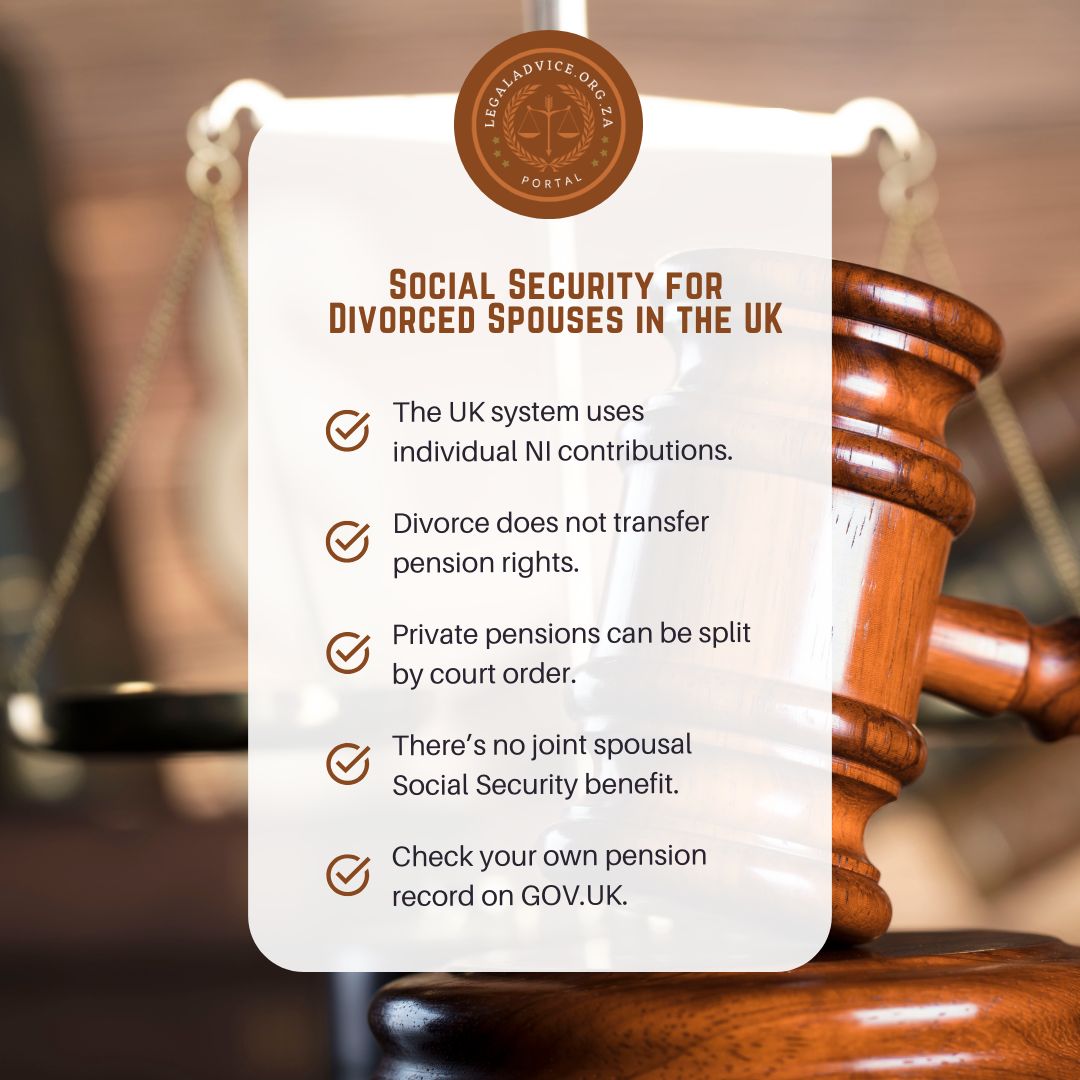
In the UK, there are no specific “social security” retirement benefits for divorced spouses. Instead, the UK system is based on an individual’s National Insurance (NI) contributions. This means your State Pension and benefits depend solely on what you have personally paid in during your working life.
That said, divorce does affect pensions in other ways. Courts can divide private and workplace pensions as part of a financial settlement. In limited cases under the old State Pension system, a divorced spouse may still be able to use their ex-partner’s NI record to increase their entitlement.
The first step to take is to identify which pension system applies to you
There are two versions of the State Pension system in the UK: the old State Pension and the new State Pension.
- If you reached pension age before 6 April 2016, you are under the old system. In this case, you may be able to claim a pension based on your ex-spouse’s National Insurance record, provided you are not remarried.
- If you reach pension age after 6 April 2016, you fall under the new system. In this system, your pension is calculated purely on your own contributions. You cannot use your former spouse’s NI record for any increase.
This distinction is important because it determines whether you have any potential entitlement connected to your ex-spouse’s contributions. Most people retiring now fall under the new system.
The second step to take is to understand how pension sharing works after divorce
During divorce proceedings in the UK, pensions are treated as part of the financial assets that must be divided fairly. Courts can issue one of three types of orders:
- Pension sharing order: transfers a portion of one person’s pension to their ex-spouse. Once the transfer happens, the share becomes a completely separate pension in the recipient’s name.
- Pension attachment order: allows a portion of pension income or lump sums to be paid to an ex-spouse when the pension starts being drawn.
- Pension offsetting: exchanges pension value for another asset such as a house or savings.
These orders apply to private and workplace pensions, not the basic State Pension. Once the order is made, your ex-spouse’s share is theirs entirely, and your responsibility for that portion ends.
The third step to take is to check how National Insurance credits may affect your pension
Many people, especially those who stayed home to raise children, may have gaps in their National Insurance record. The UK government allows certain credits to fill these gaps. For instance, if you received Child Benefit while caring for children under 12, you automatically earned NI credits.
If you are divorced and worried that your time out of work has affected your pension, you can check your NI record and apply for voluntary contributions to fill any missing years. These credits are applied individually and cannot be shared or transferred from your ex-spouse.
The fourth step to take is to find out what happens if you or your ex-spouse remarry
Under the old State Pension system, a divorced person could use their ex-spouse’s NI record only if they did not remarry before reaching pension age. Once remarried, that right was lost. Under the new system, remarriage has no effect because all entitlements are based on your own contributions.
Private and workplace pensions, once divided, remain fully independent even after remarriage. If you received a portion of your ex-spouse’s pension under a pension sharing order, that share remains yours for life.
The fifth step to take is to learn how survivor benefits work after divorce
If your ex-spouse dies, you might still be eligible for certain benefits, but these are limited. Under the old State Pension rules, a divorced individual could inherit part of their ex-partner’s Additional State Pension if they had not remarried. Under the new system, this inheritance option no longer exists.
However, if you were financially dependent on your ex-spouse, you may qualify for a Bereavement Support Payment, provided you meet specific conditions and have not remarried. This applies mostly to those with dependent children or recent bereavement cases.
How this system applies across the UK
The rules are consistent across England, Scotland, Wales, and Northern Ireland. The Department for Work and Pensions (DWP) oversees State Pension and benefits, while family courts handle financial settlements and pension division under:
- The Matrimonial Causes Act 1973 (England and Wales)
- The Family Law (Scotland) Act 1985 (Scotland)
- The Matrimonial Causes (Northern Ireland) Order 1978 (Northern Ireland)
Although the legal terminology differs slightly, the outcome is the same across all regions.
Comparison with other countries
In the United States, a divorced spouse can receive Social Security retirement benefits based on their ex-partner’s earnings if the marriage lasted at least ten years and they are over 62. The ex-spouse’s payments are not affected by this.
In the United Kingdom, this concept does not exist under the new State Pension. Each person’s entitlement is individual. Only in the old system could a divorced spouse increase their pension using their ex-partner’s NI record.
In Australia, the system also focuses on individual contributions. However, superannuation funds can be divided after divorce through court orders, similar to the UK’s pension sharing approach.
This comparison highlights that the UK system is designed around self-sufficiency rather than spousal dependency, unlike the US model.
Key differences between UK and US social security systems
| Feature | United Kingdom | United States |
|---|---|---|
| Can ex-spouse claim on your record? | Only under old pension system | Yes, if marriage lasted 10+ years |
| Based on individual contributions | Yes | No (shared record possible) |
| Type of main benefit | State Pension | Social Security |
| Remarriage effect | No impact under new system | Cancels entitlement |
| Pension sharing | Court-ordered | Not applicable |
Final thoughts on social security for divorced spouses in the UK
Social security for divorced spouses in the UK works differently from what many people expect. There is no shared benefit or automatic entitlement based on an ex-spouse’s work record. Entitlement is determined by your own National Insurance history and any pension orders agreed during the divorce. For those under the old State Pension system, limited rights exist, but for everyone retiring now under the new system, independence is key. Understanding your contributions, reviewing your pension forecast, and seeking legal or financial advice early can help secure your future and avoid confusion later in life.