

When a marriage ends, financial responsibilities and future benefits often become points of confusion. One common question is whether a divorced spouse can claim social security benefits from their former partner’s record. In the United Kingdom, this issue is often misunderstood because the UK does not operate a Social Security system in the same way the United States does. Instead, benefits such as the State Pension, Universal Credit, and other allowances are based on an individual’s personal contributions and circumstances. This article explains whether your divorced spouse can receive any benefits connected to your work record, how UK rules apply, and how this compares internationally.
Article highlights:
- Understand whether a divorced spouse can access your State Pension or social security-type benefits in the UK
- Learn how pension sharing orders work during divorce settlements
- Find out what happens if your former spouse remarries
- Compare how similar cases are handled in the United States and Australia
- Get steps to protect your pension rights after a divorce
Can My Divorced Spouse Get My Social Security Benefits in the UK?
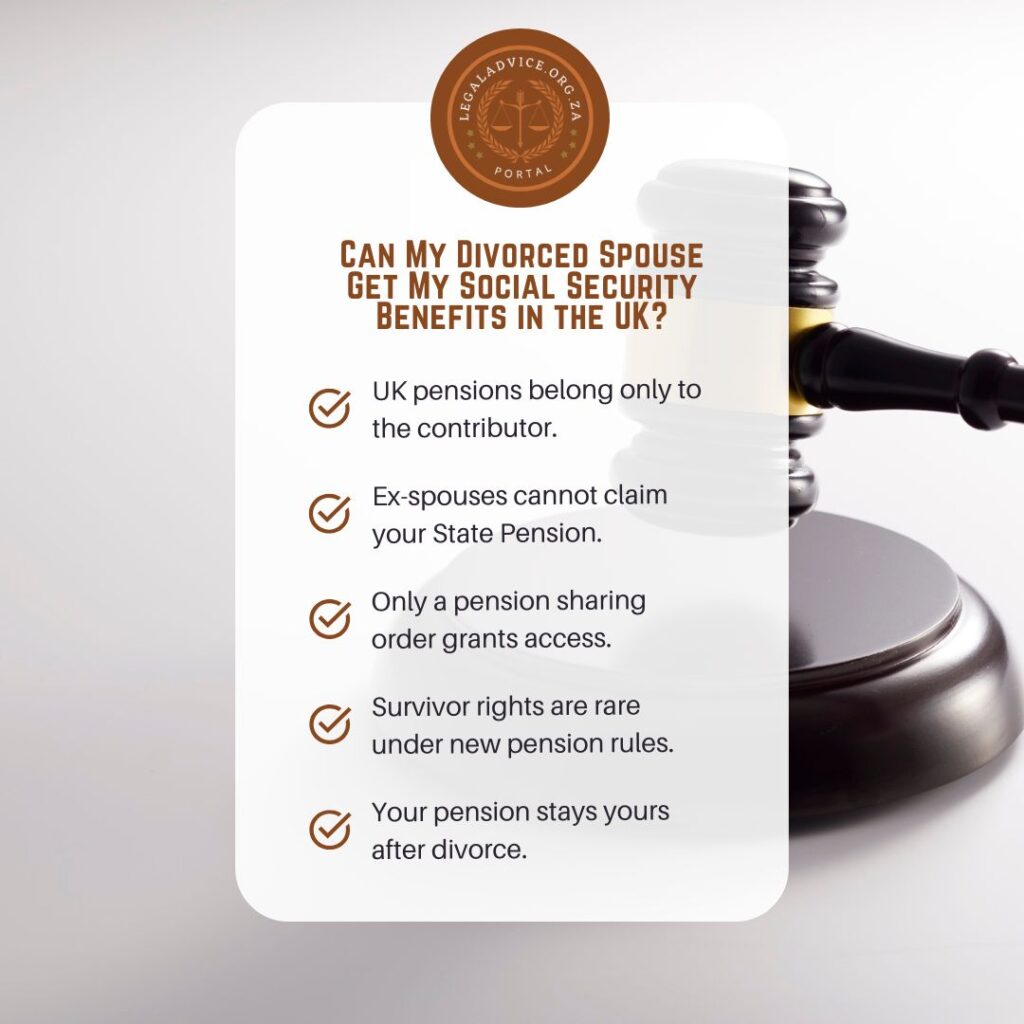
In the UK, your divorced spouse cannot directly claim your social security or State Pension benefits after divorce. The UK system is structured so that all benefits are based on personal National Insurance contributions. Once a marriage ends, each person’s entitlement stands on their own record.
However, this changes slightly if your divorce settlement includes a pension sharing order. In that case, your former spouse may receive a portion of your private or workplace pension, as decided by the court. Once transferred, that share becomes their property, and you lose control over that portion. The State Pension, on the other hand, remains unaffected unless your spouse reached pension age before April 2016 under the old system.
The first step to take is to identify which pension system applies to you
There are two main State Pension systems in the UK, and this affects whether a divorced spouse can benefit from your record.
- Old State Pension (before April 2016): Under this system, a divorced spouse could sometimes claim based on your National Insurance record, provided they were not remarried and had reached pension age before April 2016.
- New State Pension (after April 2016): This applies to anyone reaching pension age from 6 April 2016 onwards. Under this system, your ex-spouse cannot use your National Insurance contributions to boost their pension. Each person’s entitlement is calculated separately.
If you are under the new system, your pension is entirely independent, meaning your divorced spouse has no right to claim from your record after the marriage ends.
The second step to take is to understand how pension sharing works after divorce
When you divorce in the UK, all financial assets, including pensions, are considered part of the marital estate. A court can issue a pension sharing order that divides your pension benefits between you and your ex-spouse. This means a percentage of your pension is legally transferred to your ex-partner’s name.
Once this is done, the share becomes theirs to manage, and you have no future obligation. Pension sharing can apply to:
- Private pensions (such as personal or self-invested schemes)
- Workplace pensions (from an employer)
- Additional State Pension (under the old system only)
If no pension sharing order is made, your ex-spouse cannot claim any portion of your pension directly. It is important to confirm that all financial settlements are clearly finalised to avoid confusion later.
The third step to take is to check what happens if your ex-spouse remarries
If your divorced spouse remarries, they lose any rights to claim a pension based on your record under the old State Pension system. This rule was designed to prevent double entitlement. Under the new system, remarriage makes no difference, because no shared entitlement exists in the first place.
Private or workplace pension shares, once granted, remain unaffected by remarriage. Your ex-partner keeps their portion permanently, even if they enter a new marriage.
The fourth step to take is to verify your National Insurance and pension details
You can check your National Insurance contributions and forecast your State Pension on GOV.UK. Doing this ensures your record is accurate and helps you plan your retirement independently. It also prevents misunderstandings about shared entitlements after divorce.
If you are concerned about protecting your pension, it is advisable to speak with a financial adviser or solicitor who specialises in family and pension law. They can guide you on limiting exposure during divorce settlements and ensuring you retain as much of your pension as possible.
The fifth step to take is to understand exceptions involving survivor benefits
While your divorced spouse cannot claim your State Pension directly, there are limited cases where they could receive benefits after your death. For example:
- If you die before reaching pension age, your former spouse may be eligible for certain Bereavement Support Payments if they meet specific conditions, such as caring for dependent children.
- Under the old Additional State Pension (pre-2016), some divorced individuals may inherit part of their ex-spouse’s pension after death. This only applies if they have not remarried and meet other eligibility rules.
These exceptions are rare and do not apply under the new State Pension structure.
How this works across the UK
The rules are the same across England, Scotland, Wales, and Northern Ireland. Divorce settlements involving pensions are governed by the Matrimonial Causes Act 1973 in England and Wales, the Family Law (Scotland) Act 1985 in Scotland, and the Matrimonial Causes (Northern Ireland) Order 1978 in Northern Ireland.
In all regions, the Department for Work and Pensions (DWP) administers State Pensions, while private pension schemes are managed by individual providers. The division of pensions during divorce is handled through the courts, and pension providers must comply with any sharing or attachment orders.
Comparison with other countries
In the United States, a divorced spouse can receive Social Security retirement benefits based on their former partner’s earnings record if the marriage lasted at least 10 years, the person claiming is unmarried, and both are over 62. This benefit does not reduce the ex-spouse’s payments.
In the United Kingdom, there is no such entitlement under the new State Pension system. Retirement income depends solely on individual contributions. The only exception is through pension sharing orders or survivor benefits under very limited conditions.
In Australia, retirement benefits work similarly to the UK. The superannuation fund can be divided in a divorce through a formal splitting order, but once divided, each person’s entitlement is independent.
This comparison shows that while the US system allows spousal-based benefit claims, the UK and Australia prioritise individual contribution and financial independence.
Key differences between UK and US systems
| Feature | United Kingdom | United States |
|---|---|---|
| Can ex-spouse claim from your record? | No (only under old system) | Yes, if marriage lasted 10+ years |
| Type of benefit | State Pension | Social Security |
| Based on individual contributions | Yes | Shared record possible |
| Effect of remarriage | No impact under new system | Cancels entitlement |
| Pension sharing | Court-ordered division only | Not applicable |
Final thoughts on whether a divorced spouse can get your social security benefits in the UK
A divorced spouse cannot claim your social security or State Pension benefits in the UK unless a pension sharing order was made during divorce proceedings. The British system focuses on individual entitlement rather than shared retirement rights. Your former spouse can only access benefits tied to their own National Insurance contributions or to any pension portion awarded by a court. Unlike the United States, where ex-spouses can receive Social Security based on a partner’s work record, the UK system maintains financial independence after divorce. Reviewing your pension arrangements early and ensuring accurate records will protect your retirement security and avoid future misunderstandings about who is entitled to what.