

When a marriage ends, questions about long-term financial stability often arise, especially if one spouse becomes disabled and unable to work. Many people ask whether a divorced spouse can get social security disability benefits in the UK, similar to how it works in the United States. The reality is that the UK’s benefit system does not operate in the same way. In Britain, disability support is based on personal circumstances, health conditions, and work history, rather than marital status. This article explains how disability benefits work for divorced individuals in the UK, what support is available, and how it compares to other countries.
Article highlights:
- Find out whether divorced spouses can claim disability benefits in the UK
- Understand the main types of disability benefits available in Britain
- Learn how divorce affects your eligibility for government benefits
- Discover how disability benefits differ between the UK and US systems
- Get practical steps for applying for support if you are divorced and disabled
Can a Divorced Spouse Get Social Security Disability Benefits in the UK?
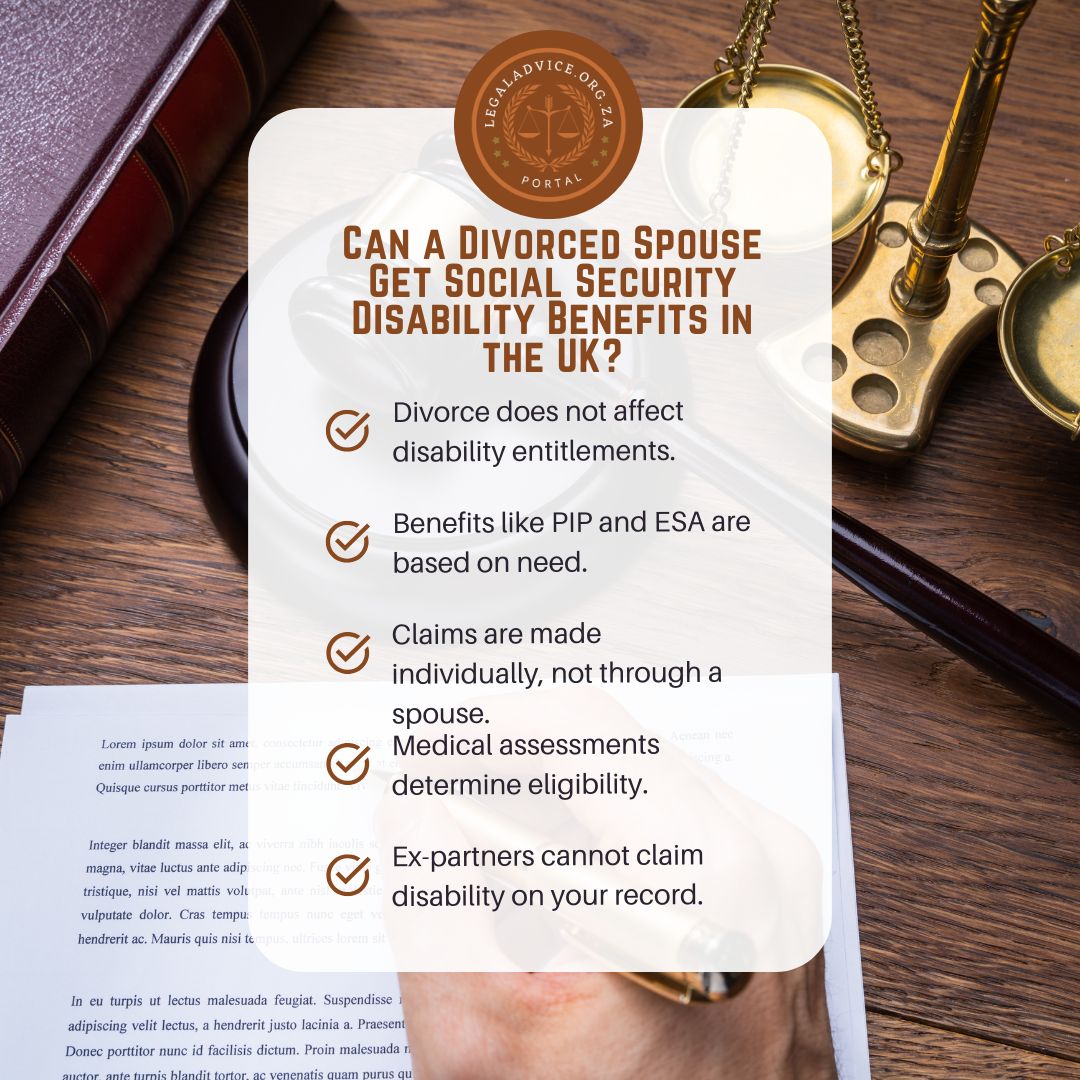
In the UK, a divorced spouse cannot claim social security disability benefits through their ex-partner’s work record or National Insurance contributions. The British system is structured differently from the American Social Security programme. Disability benefits in the UK are awarded to individuals based on their own health condition, income level, and work history.
This means that if you become disabled after divorce, your eligibility for financial assistance will depend entirely on your personal situation, not your former spouse’s. Divorce has no direct bearing on your right to claim disability benefits, but it may affect your overall household income, which can influence how much you receive under certain means-tested benefits.
The first step to take is to understand which disability benefits apply to you
The UK has several different types of disability-related benefits, each with specific criteria. The main ones include:
- Personal Independence Payment (PIP): for people aged 16 to State Pension age who have a long-term physical or mental health condition that affects daily living or mobility.
- Employment and Support Allowance (ESA): for people who cannot work due to illness or disability but have made sufficient National Insurance contributions.
- Universal Credit (limited capability for work element): for people with a disability or health condition who have a low income or are out of work.
- Attendance Allowance: for those over State Pension age who need help with personal care due to illness or disability.
Divorce does not disqualify you from any of these benefits. Each claim is assessed independently, based on your own circumstances, medical evidence, and financial position.
The second step to take is to check your National Insurance contribution record
Some disability benefits, such as Employment and Support Allowance (ESA), depend on National Insurance contributions. These contributions are made through your own work history. If you worked while married, those years still count towards your record after divorce. However, you cannot claim or share credits from your ex-partner’s record.
You can check your National Insurance record online through GOV.UK to see whether you have enough qualifying years. If you have gaps, you may be able to make voluntary contributions to improve your eligibility.
The third step to take is to consider how divorce affects your benefit calculations
While divorce does not directly change your entitlement to disability benefits, it can affect means-tested benefits such as Universal Credit. If you previously claimed as a couple, your claim will be reassessed as a single person. This could increase or decrease your payment depending on your new income and living situation.
If your former spouse paid child maintenance or you share custody of children, these payments can also influence your Universal Credit calculation. It is important to update the Department for Work and Pensions (DWP) immediately after divorce to avoid overpayment or benefit disruption.
The fourth step to take is to prepare medical and financial documentation for your claim
To apply for any disability-related benefit in the UK, you must provide strong medical evidence showing how your condition affects your daily life or ability to work. This typically includes:
- Medical reports or letters from your GP or specialist
- Hospital discharge summaries or care plans
- Details of prescribed medication and treatment history
- Financial documents if applying for means-tested benefits
For divorced applicants, proof of address, income, and child arrangements may also be requested. Keeping all records updated ensures faster processing and accurate assessments.
How disability benefits for divorced spouses work across the UK
Disability benefits are managed uniformly across England, Scotland, Wales, and Northern Ireland, but each region has its own administrative body.
- In England and Wales, claims are handled by the Department for Work and Pensions (DWP).
- In Scotland, the system is transitioning to Social Security Scotland, which now manages Adult Disability Payment (ADP), replacing PIP.
- In Northern Ireland, claims are managed by the Department for Communities.
Each region applies similar eligibility rules, meaning that divorce does not affect how claims are processed or the amount you receive.
Comparison with other countries
In the United States, a divorced spouse can receive Social Security Disability Insurance (SSDI) based on their ex-spouse’s work record if the marriage lasted at least 10 years and certain conditions are met. This allows a non-working or lower-earning ex-spouse to receive benefits connected to their former partner’s earnings.
In contrast, the UK system treats each individual separately. Disability benefits are not linked to marital status or an ex-spouse’s contributions. The focus is instead on personal medical need and work history.
In Australia, the situation is closer to the UK. The Disability Support Pension is based on medical and financial assessment, not marital history. However, income from a former partner, if still received, may affect the total benefit amount.
These comparisons show that the UK prioritises individual independence and personal need rather than family-based entitlements.
Key points about divorced spouses and disability benefits in the UK
| Aspect | United Kingdom | United States | Australia |
|---|---|---|---|
| Can claim based on ex-spouse’s record | No | Yes (if marriage lasted 10+ years) | No |
| Benefit type | PIP, ESA, UC, Attendance Allowance | SSDI | Disability Support Pension |
| Means-tested | Some | Partially | Yes |
| Managed by | DWP / Social Security Scotland | Social Security Administration | Services Australia |
Final thoughts on whether a divorced spouse can get social security disability benefits in the UK
A divorced spouse cannot get social security disability benefits in the UK through their ex-partner’s record, as the system is entirely individual. However, divorced people who are disabled or ill can still receive support through Personal Independence Payment, Employment and Support Allowance, or Universal Credit. The focus is on medical evidence, income level, and work history, not marital status. Understanding these rules early helps you secure the right benefits and maintain financial independence after divorce, even if health challenges arise.