

Data privacy is no longer a side issue in the UK — it is a legal requirement that affects every company, organisation, and individual who handles personal information. Since Brexit, the UK has followed its own version of the General Data Protection Regulation (GDPR), known as the UK GDPR. Although it mirrors the EU’s rules, there are key differences and updates that businesses must understand to stay compliant in 2025. For individuals, understanding how the UK GDPR works is essential for protecting your personal data and knowing your rights.
Here is what this article covers:
- What UK GDPR means in 2025 for both businesses and individuals
- The first steps organisations should take to comply with UK GDPR
- Common challenges and how to handle them effectively
- How UK GDPR compares to international data privacy laws
- Practical strategies to maintain compliance and protect personal information
@dataqg What is GDPR? The GDPR, or General Data Protection Regulation, is a set of rules in the European Union (EU) that gives people control over their personal information. It applies to any organization that collects data about EU residents, no matter where the organization is located. The GDPR gives people the right to access their data, have it corrected, and even ask for it to be deleted. #GDPR #DataPrivacy #EU #PrivacyRights #MyData #ControlYourData #DataProtection #InformationSecurity #OnlinePrivacy #TechLaw #YouTube #DataRegulation #DigitalRights #ConsumerRights #Europe #Tech #Security #BigData #PersonalData #RightToBeForgotten ♬ Promotional – FlyFlyMusic
Understanding UK GDPR Explained and Its Role in 2025
The first step to understanding UK GDPR is recognising that it governs how organisations collect, store, and use personal data. Personal data includes any information that can identify a person, such as names, addresses, phone numbers, photos, IP addresses, or financial details. The law applies to all UK-based organisations, as well as international companies that process the data of people living in the UK.
The UK GDPR is built on seven key principles:
- Lawfulness, fairness, and transparency
- Purpose limitation (data collected for a specific purpose only)
- Data minimisation (only what is necessary should be collected)
- Accuracy (data must be kept up to date)
- Storage limitation (data should not be kept longer than needed)
- Integrity and confidentiality (data must be securely stored)
- Accountability (organisations must show compliance)
For example, a small online retailer that collects customers’ emails for order tracking cannot legally use that same list to send promotional messages without getting consent first.
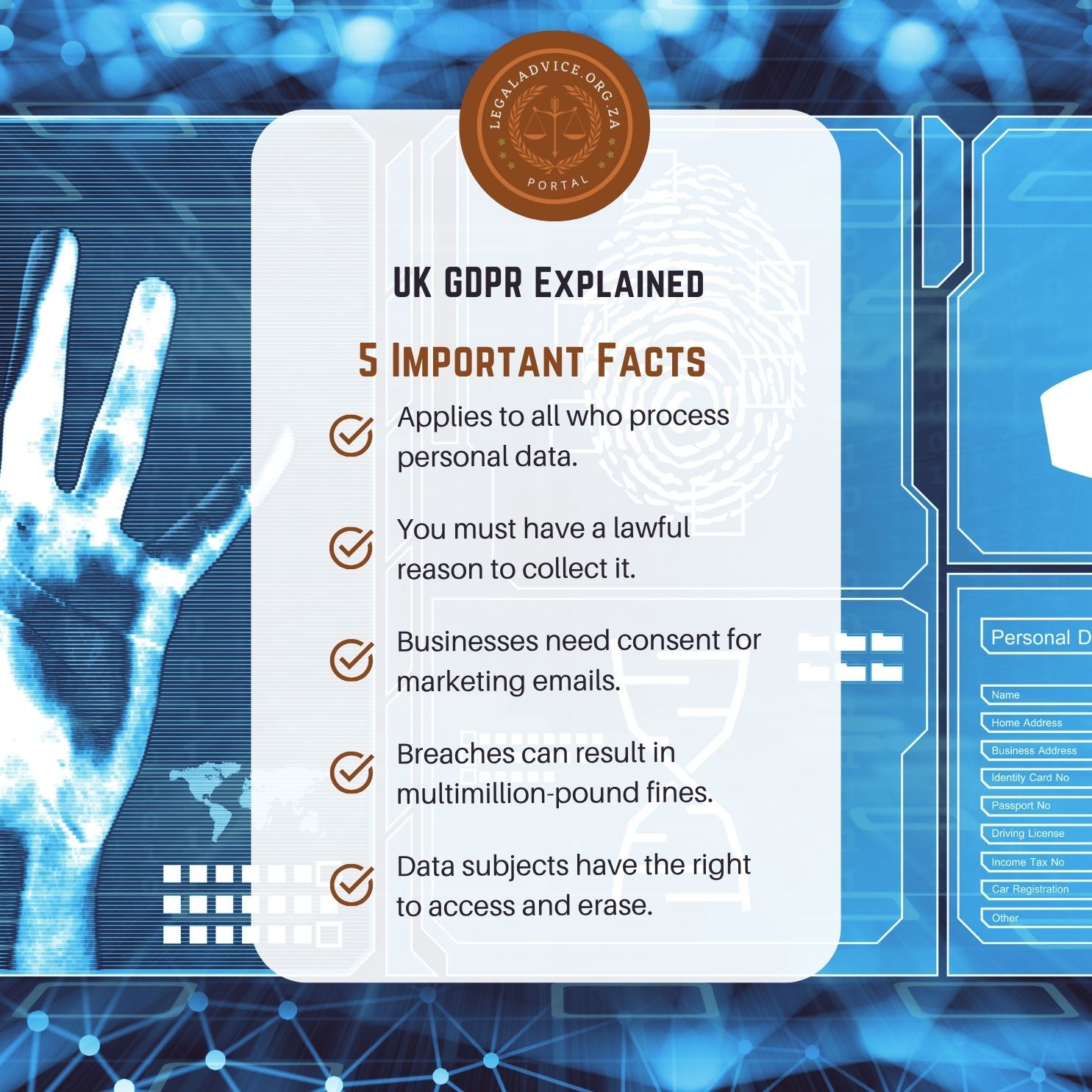
The UK GDPR is enforced by the Information Commissioner’s Office (ICO), which can issue fines of up to £17.5 million or 4% of a company’s global turnover, whichever is higher. These penalties show how seriously the UK government treats data protection breaches.
| Principle | Description | Example |
|---|---|---|
| Transparency | Tell people how data will be used | Clear privacy policy on website |
| Data minimisation | Collect only what is needed | Avoid asking for full ID when email is enough |
| Accuracy | Keep data updated | Remove outdated customer information |
| Accountability | Prove compliance | Maintain a data processing log |
Step 1: Identify What UK GDPR Requires You to Do
The first action to take for UK GDPR compliance is to understand whether your organisation is a data controller or a data processor. Data controllers decide how and why personal data is used, while data processors handle it on behalf of controllers.
The second step is to conduct a data audit. This means identifying what personal data you collect, where it comes from, how it is stored, who has access to it, and how long it is kept. This is often called “data mapping”.
The third step is to review your legal basis for processing data. Under UK GDPR, there are six lawful bases: consent, contract, legal obligation, vital interests, public task, and legitimate interests. You must clearly document which one applies to each activity.
For instance, a gym may collect member contact information under a “contractual obligation”, while it uses CCTV footage for “legitimate interests” such as safety and security.
| Step | Action | Purpose |
|---|---|---|
| 1 | Determine controller or processor status | Defines your legal responsibilities |
| 2 | Audit all personal data collected | Identifies risks and weak points |
| 3 | Record lawful basis for each activity | Ensures compliance with UK GDPR |
Step 2: Prevent the Common Mistakes Organisations Make
The first mistake many organisations make is failing to get valid consent. Under UK GDPR, consent must be freely given, specific, informed, and unambiguous. Pre-ticked boxes or silence do not count.
The second mistake is not updating privacy notices. These must clearly explain what data you collect, why you collect it, and how long you keep it. Privacy notices should also tell individuals about their right to access, correct, or delete their information.
The third mistake is neglecting data security. Losing personal information through cyberattacks or carelessness can lead to fines and reputational damage. Encryption, staff training, and secure storage systems are essential.
For example, a recruitment agency that stores CVs on shared folders without passwords could face penalties if those files are accessed by unauthorised staff.
| Mistake | Description | Prevention |
|---|---|---|
| Invalid consent | Using vague or pre-selected options | Obtain clear, active consent |
| Outdated privacy notice | Failing to update policies | Review regularly and make public |
| Weak data security | Poor storage or access control | Use encryption and staff training |
| Ignoring rights requests | Not responding to data access requests | Set clear internal procedures |
Step 3: Compare UK GDPR with International Privacy Laws
While UK GDPR shares its roots with the EU GDPR, there are growing differences as the UK adapts its own rules post-Brexit.
In the EU, GDPR continues to apply across all member states, but the European Commission monitors data transfers closely. UK businesses that handle EU data must still comply with EU GDPR to maintain trade relationships.
In South Africa, the Protection of Personal Information Act (POPIA) is similar in spirit to GDPR but has a more localised enforcement structure. The Information Regulator oversees compliance and focuses heavily on consent and cross-border data sharing.
In the United States, data privacy is regulated by state-level laws such as the California Consumer Privacy Act (CCPA). This system is less uniform, and enforcement varies by region.
| Country | Main Law | Scope | Enforcement Strength |
|---|---|---|---|
| United Kingdom | UK GDPR | National | High (ICO enforcement) |
| European Union | EU GDPR | Cross-border | Very High |
| South Africa | POPIA | Domestic | Moderate |
| United States | CCPA (state-based) | State-specific | Variable |
These comparisons show that UK GDPR maintains strong international credibility, allowing British companies to trade and exchange data globally while ensuring high privacy standards.
Step 4: Strengthen Your UK GDPR Compliance Strategy
The first step to strengthening compliance is appointing a Data Protection Officer (DPO) if required. Large organisations and those handling sensitive data must have a DPO to oversee data protection policies and staff training.
The second step is to implement regular data protection impact assessments (DPIAs). These help identify potential risks when introducing new technologies or collecting new types of data.
The third step is to train employees. Every staff member who handles data must understand the basics of UK GDPR, from using strong passwords to recognising phishing attempts.
The fourth step is to prepare for data breaches. Organisations must report serious breaches to the ICO within 72 hours and notify affected individuals if their rights are at risk.
For example, an accounting firm that discovers an unauthorised email containing client data was sent to the wrong person must report the incident promptly to avoid further penalties.
| Action | Description | Outcome |
|---|---|---|
| Appoint a DPO | Oversees compliance and training | Improves accountability |
| Conduct DPIAs | Assesses risks before data projects | Prevents privacy breaches |
| Train staff | Builds awareness and responsibility | Reduces careless mistakes |
| Plan for data breaches | Report within 72 hours | Maintains transparency and trust |
Step 5: Understand Your Rights as an Individual Under UK GDPR
UK GDPR gives individuals strong control over how their data is used. Knowing these rights helps you challenge misuse or demand corrections.
The first right is access. You can request to see what personal data an organisation holds about you. The organisation must respond within one month.
The second right is rectification. You can ask for errors in your data to be corrected or updated.
The third right is erasure, often known as the “right to be forgotten”. You can request deletion of your data if it is no longer needed or was collected unlawfully.
The fourth right is data portability, allowing you to transfer your data between organisations in a readable format.
For instance, a customer switching from one energy supplier to another may ask the old provider to transfer their usage data securely to the new one under the right to data portability.
| Right | Description | Response Time |
|---|---|---|
| Access | See what data is held about you | 1 month |
| Rectification | Correct errors in personal data | 1 month |
| Erasure | Request deletion of information | 1 month |
| Portability | Transfer data to another service | 1 month |
| Objection | Refuse processing for marketing | Immediate effect |
Reflecting on UK GDPR in 2025
The UK GDPR remains a strong and detailed framework for protecting personal information in an increasingly digital society. For businesses, it demands accountability, transparency, and respect for individuals’ privacy. For citizens, it provides the power to control personal data and challenge misuse. As 2025 progresses, technology such as artificial intelligence and automated profiling will continue to test the limits of the law, but the core principles of fairness and respect remain constant. Understanding and applying UK GDPR correctly is not just about avoiding fines — it is about building trust in a world where privacy is the new currency.