

Life insurance exists to give families financial security when a loved one passes away. However, when the insurer refuses to pay or delays a payout, it can create enormous stress during an already painful time. Life insurance policy disputes in the UK often come down to unclear terms, missing documents, or disagreements about disclosure. Understanding how these disputes arise and how they are resolved helps families protect what they are entitled to.
Here is what this article covers:
- Common reasons for life insurance policy disputes in the UK
- The first steps to take when a life insurance claim is rejected
- How disputes are resolved through complaint and review processes
- How the UK approach compares with other countries
- Practical steps to avoid disputes in future policies
@financemattersuk life insurance isn’t the only policy to be considering btw
♬ original sound – Fis | Finance Matters UK
Understanding Life Insurance Policy Disputes in the UK
The first step to understanding life insurance policy disputes in the UK is to look at how life insurance works. When someone takes out a policy, they pay regular premiums in exchange for a payout to their beneficiaries upon death. The payout amount, terms, and conditions are stated in the policy. Problems arise when the insurer believes that a condition of the contract was breached.
Most disputes fall under four categories: non-disclosure, lapsed policies, claim delays, and disagreement over cause of death.
For example, a widow might face rejection if her late husband did not disclose a pre-existing heart condition when applying for the policy. Even if the omission was not intentional, the insurer can argue that it affected their decision to provide cover.
| Common Cause | Description | Example |
|---|---|---|
| Non-disclosure | Policyholder failed to declare medical or lifestyle details | Undisclosed diabetes or smoking habit |
| Policy lapse | Missed premium payments cause cover to end | Stopped paying for three months |
| Claim delay | Disagreement over documents or cause of death | Death certificate not aligned with claim report |
| Disputed cause | Insurer questions whether death is covered | Death ruled as suicide within exclusion period |
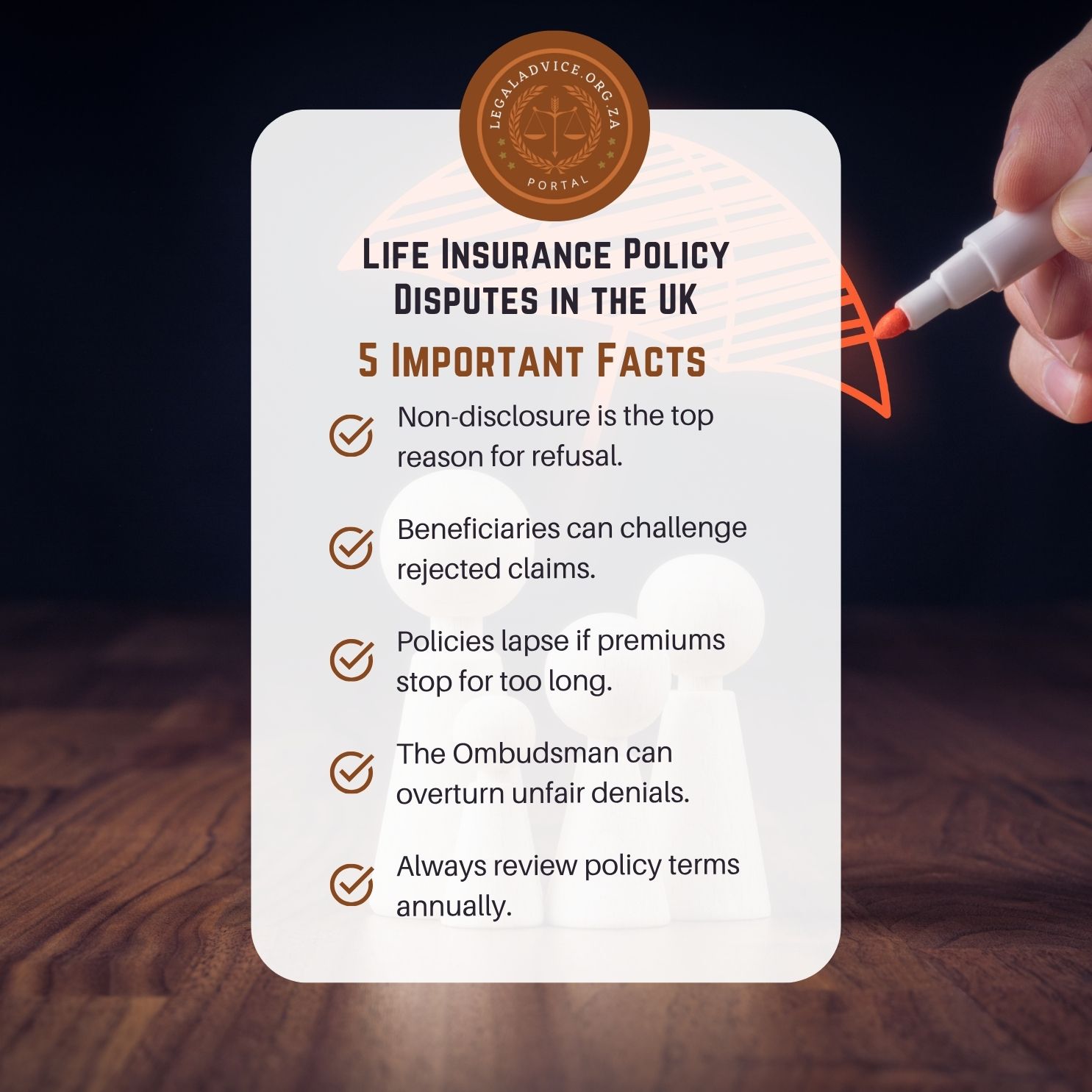
Step 1: Identify the Reason Behind the Dispute
The first step to take when facing a life insurance policy dispute in the UK is to identify exactly why the claim was denied. The insurer must send a written explanation outlining their reason.
The second step is to check the policy schedule and terms. Look closely at sections on exclusions, claim procedures, and payment conditions. Some policies exclude payouts within the first twelve months if the death resulted from suicide or undisclosed illness.
The third step is to request the insurer’s internal notes and assessment report. Under the UK GDPR, beneficiaries have a right to access information that led to the claim decision.
For instance, a family might find that an insurer denied a claim based on outdated medical information rather than verified records from the GP.
| Step | Action | Purpose |
|---|---|---|
| 1 | Request insurer’s written reason | Clarify the basis of denial |
| 2 | Review policy terms | Identify exclusions or conditions |
| 3 | Access assessment records | Find inconsistencies or errors |
Step 2: Gather Evidence to Support the Claim
After identifying the reason for rejection, the next step is to gather strong supporting evidence. Collect all relevant documents, including medical records, hospital reports, correspondence with the insurer, and proof of premium payments.
If the insurer argues non-disclosure, evidence from the deceased’s GP or hospital can prove whether the information would have changed the insurer’s decision. In many cases, insurers cannot reject a claim for innocent or minor non-disclosure under the Consumer Insurance (Disclosure and Representations) Act 2012.
For example, if a policyholder forgot to mention mild asthma that had no impact on their death, the insurer’s refusal could be challenged as unreasonable.
| Evidence Type | Description | Purpose |
|---|---|---|
| Medical records | GP and hospital notes | Show disclosed or irrelevant conditions |
| Payment receipts | Premium payment proof | Confirm policy remained active |
| Correspondence | Emails or letters from insurer | Show timelines and handling quality |
| Death certificate | Official cause of death | Verify claim’s eligibility |
Step 3: File a Complaint and Escalate When Necessary
The first step in resolving a life insurance policy dispute in the UK is to use the insurer’s internal complaint process. Write a formal complaint explaining why the rejection or delay is unfair and include all supporting evidence.
The insurer has up to eight weeks to respond. During this period, they may reopen the investigation, request more documents, or issue a final response letter.
If you disagree with their decision or they fail to respond, the next step is to take the matter to the Financial Ombudsman Service (FOS). The FOS reviews life insurance policy disputes independently and can order insurers to pay out if they find unfair treatment.
For instance, a son who challenges his father’s rejected claim may win after the Ombudsman finds that the insurer misinterpreted a medical report.
| Step | Action | Timeframe |
|---|---|---|
| 1 | Submit written complaint | Immediately after dispute |
| 2 | Await insurer’s response | Within 8 weeks |
| 3 | Escalate to FOS | Within 6 months of final response |
Step 4: Learn from How Other Countries Handle Life Insurance Disputes
The United Kingdom has one of the most structured systems for resolving life insurance disputes. The Financial Ombudsman Service provides an accessible, free process that is legally binding for insurers once accepted by the claimant.
In Australia, the Australian Financial Complaints Authority (AFCA) handles similar disputes and also offers legally binding outcomes.
In South Africa, complaints go through the Ombudsman for Long-term Insurance. While this office helps consumers, its recommendations are not always binding, and insurers can refuse to comply.
In the United States, each state has its own insurance regulator. Dispute resolution often relies on mediation or lawsuits, which can be expensive and lengthy.
| Country | Dispute Resolution Body | Cost | Binding Decision |
|---|---|---|---|
| United Kingdom | Financial Ombudsman Service | Free | Yes |
| Australia | AFCA | Free | Yes |
| South Africa | Long-term Insurance Ombudsman | Free | Usually No |
| United States | State Regulators / Courts | Varies | Depends on state |
These comparisons show that the UK’s structure protects consumers better than most, ensuring fair and efficient outcomes without court intervention.
Step 5: Prevent Future Life Insurance Policy Disputes
The first step to prevent future disputes is to provide full and honest information when applying for life cover. Even small omissions about health, occupation, or travel habits can cause serious problems later.
The second step is to review the policy every year. Ensure the listed beneficiaries, coverage amount, and personal details remain accurate.
The third step is to keep all payment and communication records in one place. These will make any future claims smoother.
For example, a couple who review their life insurance policy annually can correct details such as new medical conditions or changes in address, avoiding confusion during a claim.
| Preventive Step | Description | Benefit |
|---|---|---|
| Disclose everything honestly | Declare all medical and lifestyle details | Avoid invalid claims |
| Review yearly | Update beneficiaries and policy details | Ensure coverage remains relevant |
| Keep records | Store emails, receipts, and letters | Simplify future claims |
Reflecting on Life Insurance Policy Disputes in the UK
Life insurance policy disputes in the UK can feel overwhelming, but they are rarely without resolution. Families who stay informed, gather proper evidence, and follow the correct complaint process often succeed in securing what is rightfully theirs. The system is designed to protect both fairness and transparency, giving every policyholder a clear route to challenge decisions. Life insurance is ultimately about security, and knowing how to navigate a dispute keeps that promise intact when it matters most.