

Every shopper has faced it at least once – you buy something that doesn’t work as it should. It could be a washing machine that breaks after a few uses, a phone that freezes constantly, or furniture that falls apart within weeks. The good news is that the law is on your side. Faulty goods in the UK fall under clear consumer protection rules that give you the right to repair, replace, or refund your purchase. Knowing how these rights work, and when to use them, can save you both frustration and money.
Here is what this article covers:
- The laws that protect you when you buy faulty goods in the UK
- The steps to take to get a repair, replacement, or refund
- Common challenges when dealing with retailers and how to handle them
- How other countries approach consumer protection and faulty goods
- Practical tips to use your rights effectively in 2026
@tiktokstreetlawyer Quick consumer rights tip. Faulty goods #tiktokstreetlawyer #communitylegaleducation #uksolicitor #consumer #shop #phone #washingmachine #fyp ♬ original sound – Street Lawyer
Understanding Faulty Goods in the UK
The first step to understanding faulty goods in the UK is knowing what the law means by “faulty”. Goods are considered faulty if they are not as described, not fit for purpose, or not of satisfactory quality. These rules come from the Consumer Rights Act 2015, which applies to both physical and digital products bought in-store or online.
Under these laws, when you buy a product, you are entitled to expect it to work properly for a reasonable period. If it breaks down, doesn’t do what it was sold to do, or turns out to be different from its description, you have clear options. The same rules apply to used goods and sale items, as long as the defect was not pointed out before the purchase.
For example, if you buy a new television that stops working within two weeks, it is automatically considered faulty under UK consumer law.
Digital goods like software, apps, or online games are also protected. If a downloaded app does not work or damages your device, you can ask for a repair, replacement, or refund in the same way as with physical goods.
Step 1: Take Immediate Action When Goods Are Faulty
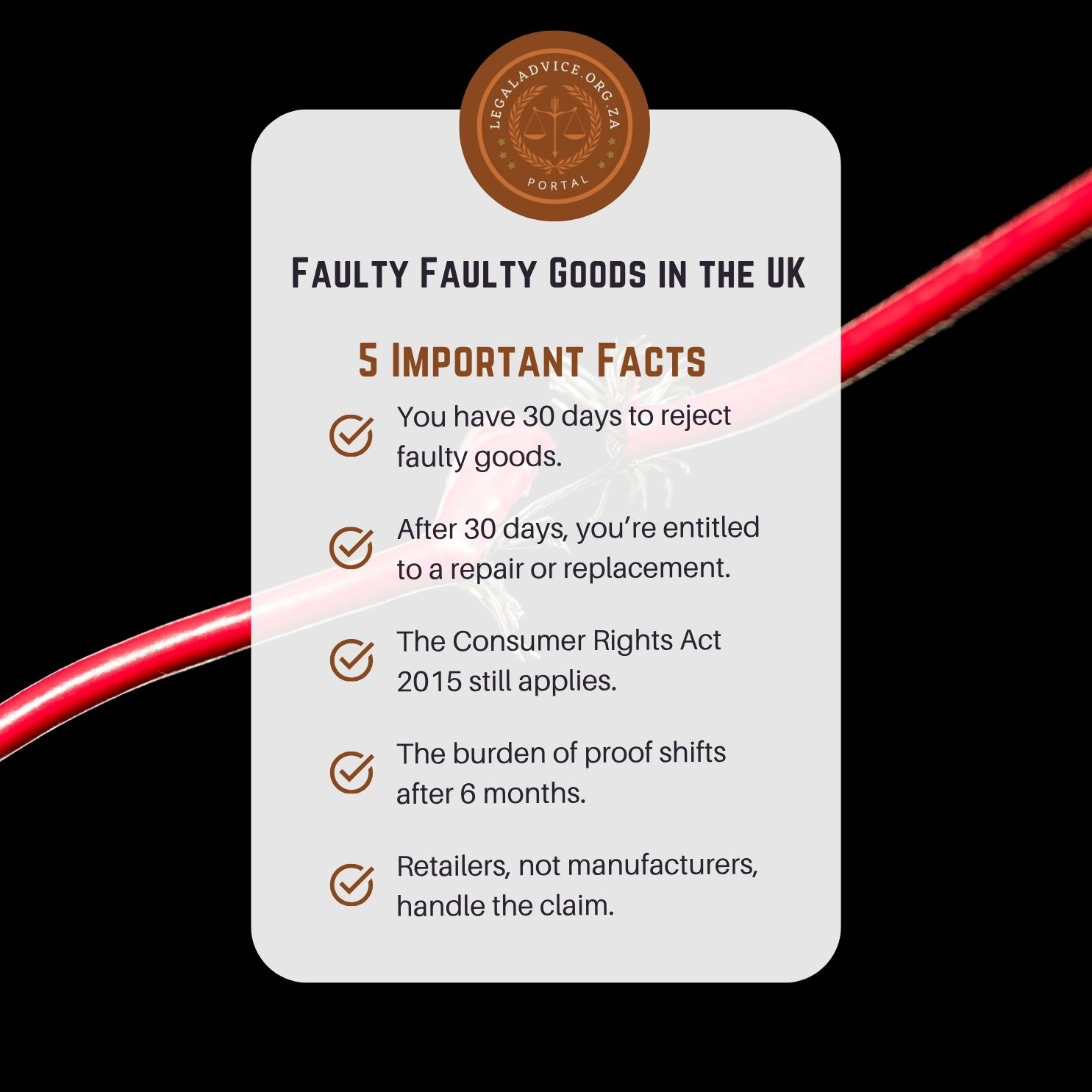
The first step when you realise you have faulty goods in the UK is to act quickly. You have a short-term right to reject the item and request a full refund within 30 days of purchase. This right applies whether you bought the item online, in-store, or through a catalogue.
If you report the problem after 30 days but within six months, the retailer must offer a repair or replacement first. If neither of these options works or takes too long, you can still demand a refund or a price reduction.
For instance, if you purchase a washing machine that stops working after six weeks, the retailer must either fix it or replace it at no cost to you.
The second step is to contact the seller directly. Do not contact the manufacturer first unless the product came with a separate warranty. The retailer is legally responsible for resolving the issue because your contract is with them, not the brand.
Keep receipts, order confirmations, or any form of proof of purchase. Even bank statements can be used if you do not have the original receipt. Always communicate in writing so that you have a record of your complaint and their response.
| Timeframe | Your Rights | Retailer’s Obligation |
|---|---|---|
| 0–30 days | Full refund | Must refund in full |
| 31 days–6 months | Repair or replacement | Must act promptly and free of charge |
| 6 months–6 years | Possible refund or repair | Must prove goods were not faulty at sale |
Step 2: Handle Common Disputes the Right Way
The first common issue consumers face is when retailers refuse to take responsibility and direct them to the manufacturer. Under UK law, this is incorrect. The retailer must handle complaints about faulty goods in the UK, not the brand.
The second issue arises when repairs take too long. Retailers must complete repairs within a reasonable timeframe and without causing significant inconvenience. If the repair fails or the problem reappears, you can ask for a replacement or refund instead.
The third issue is when retailers argue that you caused the damage. After six months from the date of purchase, the burden of proof shifts, meaning you must show that the goods were faulty when you received them. This can be done using inspection reports, photos, or repair assessments.
For example, if a smartphone battery swells after eight months, you may need an independent report to show that it was a manufacturing fault rather than misuse.
If you paid by credit card, you have additional protection under Section 75 of the Consumer Credit Act, which makes your card provider jointly liable for the purchase if it cost between £100 and £30,000.
| Problem | Your Right | What to Do |
|---|---|---|
| Retailer refuses help | Right to refund or replacement | Quote the Consumer Rights Act |
| Repair takes too long | Right to refund | Give written notice and a deadline |
| Dispute over fault | Right to evidence review | Get independent inspection |
| Paid by credit card | Section 75 protection | Contact your card provider |
Step 3: Learn How Other Countries Handle Faulty Goods
In South Africa, the Consumer Protection Act 68 of 2008 gives consumers similar rights to repair, replace, or refund. However, South African law allows only six months for returns or repairs, compared to the UK’s longer window of up to six years for some claims.
In Australia, the Australian Consumer Law provides strong protections as well. Consumers can demand refunds or replacements if a product fails to meet acceptable quality standards. There is no strict time limit, but the expectation depends on the product’s type and price.
In the United States, warranty laws vary by state. Some states follow the Magnuson-Moss Warranty Act, which ensures repairs or refunds for defective goods, but consumers often rely more on store policies and manufacturer guarantees than legal rights.
| Country | Legal Framework | Return Period | Main Limitation |
|---|---|---|---|
| United Kingdom | Consumer Rights Act 2015 | 30 days refund, 6 months repair | Must prove fault after 6 months |
| South Africa | Consumer Protection Act 2008 | 6 months | Shorter return period |
| Australia | Australian Consumer Law | Flexible | Depends on product lifespan |
| United States | State Warranty Laws | Varies | Limited by manufacturer policies |
These comparisons show that UK consumers have some of the strongest rights in the world, particularly regarding long-term protection and retailer accountability.
Step 4: Use Smart Strategies to Enforce Your Rights
The first step to enforcing your rights is to stay calm and factual when dealing with retailers. Always reference the Consumer Rights Act and provide clear evidence.
The second step is to follow up in writing. Emails or letters should include your order number, the nature of the fault, the date of purchase, and what resolution you expect—repair, replacement, or refund.
The third step is to escalate if necessary. If the retailer refuses to cooperate, contact a consumer arbitration service or trading standards office for mediation. For example, a customer who bought a faulty laptop and received no response after multiple emails can escalate to a consumer ombudsman for free assistance.
The final step is to stay persistent. Most disputes are resolved once retailers realise you understand your rights. Being informed is the most powerful tool you have as a consumer.
| Step | Action | Outcome |
|---|---|---|
| 1 | Stay calm and refer to the law | Keeps communication professional |
| 2 | Submit a written complaint | Creates a clear record |
| 3 | Escalate through arbitration | Encourages fair resolution |
| 4 | Stay persistent | Increases success rate |
Reflecting on Faulty Goods in the UK
Faulty goods in the UK are no longer something consumers must quietly accept. The law gives every buyer strong protection to ensure that products meet basic quality standards. Retailers have clear duties, and consumers have straightforward routes to repair, replace, or refund. These rules apply equally to physical and digital purchases, reflecting how modern shopping has changed. By understanding your rights, acting quickly, and keeping proper records, you can make sure that when something goes wrong, you get the fair outcome you deserve.