

Environmental standards are tightening across the United Kingdom. With new sustainability targets and stricter enforcement rules coming into effect, environmental regulation in the UK has become a critical issue for businesses of all sizes. Whether you run a manufacturing plant, transport company, or agricultural operation, staying compliant with the 2026 regulations will determine your reputation, eligibility for contracts, and long-term survival.
Here is what this article covers:
- The main environmental regulation changes in the UK for 2026
- The first steps to take to ensure compliance
- How inspections and penalties work under the new framework
- How the UK compares with other countries on environmental law
- Strategies businesses can use to stay compliant and sustainable
Understanding Environmental Regulation in the UK
The first step to understanding environmental regulation in the UK is recognising that it is enforced through multiple bodies. These include the Environment Agency (England), Natural Resources Wales, the Scottish Environment Protection Agency (SEPA), and the Northern Ireland Environment Agency. Each has authority over waste management, pollution control, and resource use.
The core law guiding environmental compliance remains the Environmental Protection Act 1990, supported by the Environmental Permitting (England and Wales) Regulations 2016. By 2026, these frameworks are being strengthened to include tighter reporting on greenhouse gas emissions, waste reduction, and energy efficiency.
For example, a packaging company that fails to document how it manages plastic waste can now face penalties or even lose its operating licence under new waste traceability rules.
| Area of Regulation | Main Requirement | Enforcement Authority |
|---|---|---|
| Waste management | Proper disposal, tracking, and recycling | Environment Agency |
| Air emissions | Monitor and limit pollutants | SEPA, EA |
| Water quality | Prevent chemical or wastewater discharge | Local councils, EA |
| Energy use | Improve efficiency and reduce emissions | BEIS, Ofgem |
| Biodiversity | Avoid damage to protected habitats | Natural England |
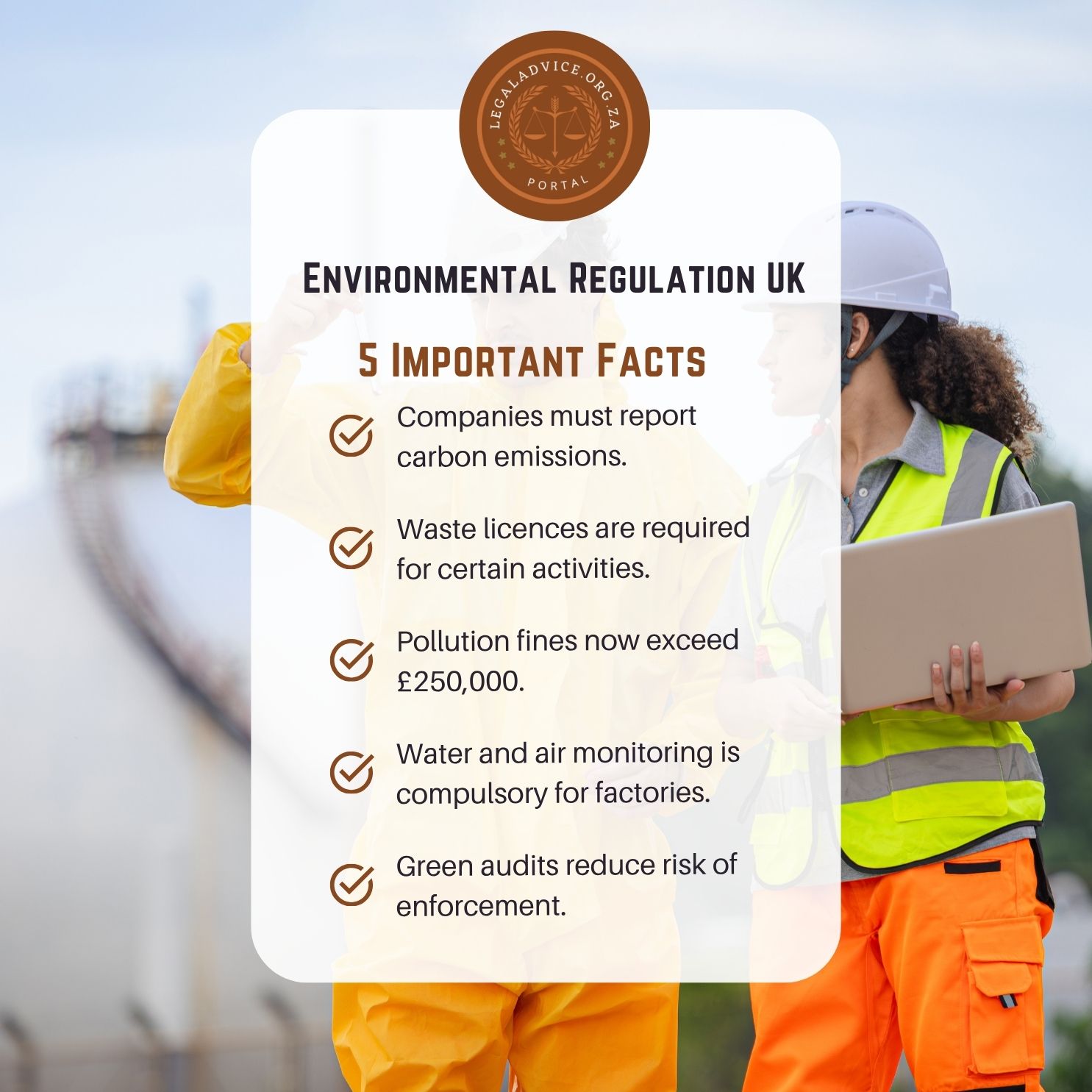
Step 1: Identify Which Environmental Rules Apply to Your Business
The first step to take is to identify which environmental regulations directly affect your industry. Manufacturing and construction face different requirements from retail or service-based businesses. You can check your permit category under the Environmental Permitting Regulations to see what activities are regulated.
The second step is to assess your environmental impact through an internal audit. This helps identify areas such as waste output, carbon emissions, or energy usage that require attention.
The third step is to ensure that you have valid environmental permits. Many businesses fail compliance audits because their permits are outdated or incomplete.
For instance, a small metal fabrication workshop might not realise it needs an environmental permit for waste oil storage until inspected by the Environment Agency.
| Step | Action | Purpose |
|---|---|---|
| 1 | Identify relevant regulations | Determine what applies to your sector |
| 2 | Conduct environmental audit | Find compliance gaps |
| 3 | Review permits | Ensure legal authorisation for operations |
Step 2: Prepare for 2026 Compliance Inspections
The initial action to take is to set up proper monitoring systems for emissions, waste, and energy consumption. Inspectors now expect digital logs rather than paper records.
The second step is to appoint an environmental compliance officer within your business. This person ensures that reporting deadlines, permit renewals, and inspection requirements are met.
The third step is to maintain communication with local regulators. Many enforcement agencies now offer advisory visits to help businesses correct issues before penalties occur.
For example, a dairy farm in Somerset avoided fines after proactively inviting the Environment Agency to review its waste-water system before the new rules came into force.
| Action | Description | Benefit |
|---|---|---|
| Install monitoring tools | Track emissions and waste digitally | Simplifies compliance |
| Assign compliance officer | Manage audits and reports | Central accountability |
| Engage regulators early | Request advisory feedback | Prevents future penalties |
Step 3: Understand How Enforcement and Penalties Work
The first step to take is to recognise that enforcement in the UK now operates on a risk-based approach. Businesses that show repeated non-compliance are subject to more frequent inspections and higher fines.
The second step is to familiarise yourself with the new civil penalty structure. By 2026, fines can reach millions of pounds for large corporations that pollute or fail to report emissions. Small and medium enterprises (SMEs) face proportionate penalties but can still be severely affected.
The third step is to respond quickly to any enforcement notice. Delays in addressing corrective actions often increase penalties.
For instance, a waste-processing company in Manchester was fined heavily after ignoring repeated warnings about unsealed hazardous containers on its site.
| Violation Type | Possible Penalty | Enforcement Body |
|---|---|---|
| Failure to report emissions | Fixed penalty or criminal prosecution | Environment Agency |
| Illegal waste dumping | Unlimited fines and imprisonment | Local courts |
| Breach of water discharge permit | Fines and operational suspension | EA or SEPA |
Step 4: Learn How Other Countries Handle Environmental Regulation
In the United Kingdom, enforcement combines national oversight with local accountability, ensuring a balance between environmental protection and business viability.
In Germany, environmental regulation is even stricter. Industrial polluters are required to invest in green technology or face heavy taxes. Compliance audits are more frequent but supported by government-funded environmental consultants.
In Australia, each state enforces its own environmental rules, creating inconsistency but allowing local adaptation.
In South Africa, environmental laws exist but enforcement is weaker, with limited inspection capacity. Many companies rely on voluntary compliance to avoid legal issues.
| Country | Enforcement System | Business Impact |
|---|---|---|
| United Kingdom | National and local regulators | Balanced, structured enforcement |
| Germany | Strong federal oversight | High compliance cost but efficient outcomes |
| Australia | State-based systems | Varied enforcement by region |
| South Africa | Limited capacity | Inconsistent compliance culture |
These comparisons show that the UK remains one of the most stable and predictable environments for environmental regulation, combining strong oversight with business support programmes.
Step 5: Strengthen Internal Sustainability Practices
The first step for businesses aiming to go beyond basic compliance is to integrate environmental responsibility into company policy. Sustainability goals should align with business strategy and employee performance indicators.
The second step is to reduce waste through circular economy practices. Reusing materials, improving recycling systems, and designing products with longer lifespans reduce both costs and emissions.
The third step is to invest in renewable energy sources such as solar panels or green power contracts. This not only supports compliance but also enhances reputation among clients and investors.
For example, a logistics firm in Birmingham cut its operating costs by installing solar panels on warehouse roofs, reducing grid electricity use by 40 percent.
| Action | Description | Result |
|---|---|---|
| Align policy with compliance | Embed environmental goals in company strategy | Improved accountability |
| Adopt circular economy model | Reduce, reuse, recycle | Lower waste management costs |
| Invest in renewable energy | Use solar, wind, or green tariffs | Long-term savings and reputation gains |
Reflecting on Environmental Regulation in the UK
Environmental regulation in the UK is evolving rapidly as the government pushes toward net-zero emissions by 2050. The new 2026 compliance rules will not only hold businesses accountable but also reward those who invest early in sustainability. Companies that treat compliance as an opportunity rather than a burden will find themselves more competitive, resilient, and respected in the years ahead.