

The divorce process in the UK can feel overwhelming at first, especially for those going through it for the first time. It involves a combination of legal, emotional, and financial steps that must be handled carefully. Many people are unsure how long the process takes, what documents are needed, or how much control they have over the outcome. Understanding the divorce process in the UK is vital for anyone seeking to separate from their spouse fairly, calmly, and within the law.
Before diving into the details, here is a short overview of what this article will unpack:
- How the divorce process in the UK works step-by-step and what documents you will need
- The expected timeline for each stage and what can delay the process
- The role of financial settlements and child arrangements during divorce
- How divorce in the UK compares to systems in South Africa, Australia, and the United States
- What practical steps you can take to keep the divorce process as smooth and affordable as possible
@thelegalqueen Do it yourself! #divorce #uk #solicitor #familylaw #solicitorsoftiktok ♬ original sound – The Legal Queen
Understanding the Divorce Process in the UK
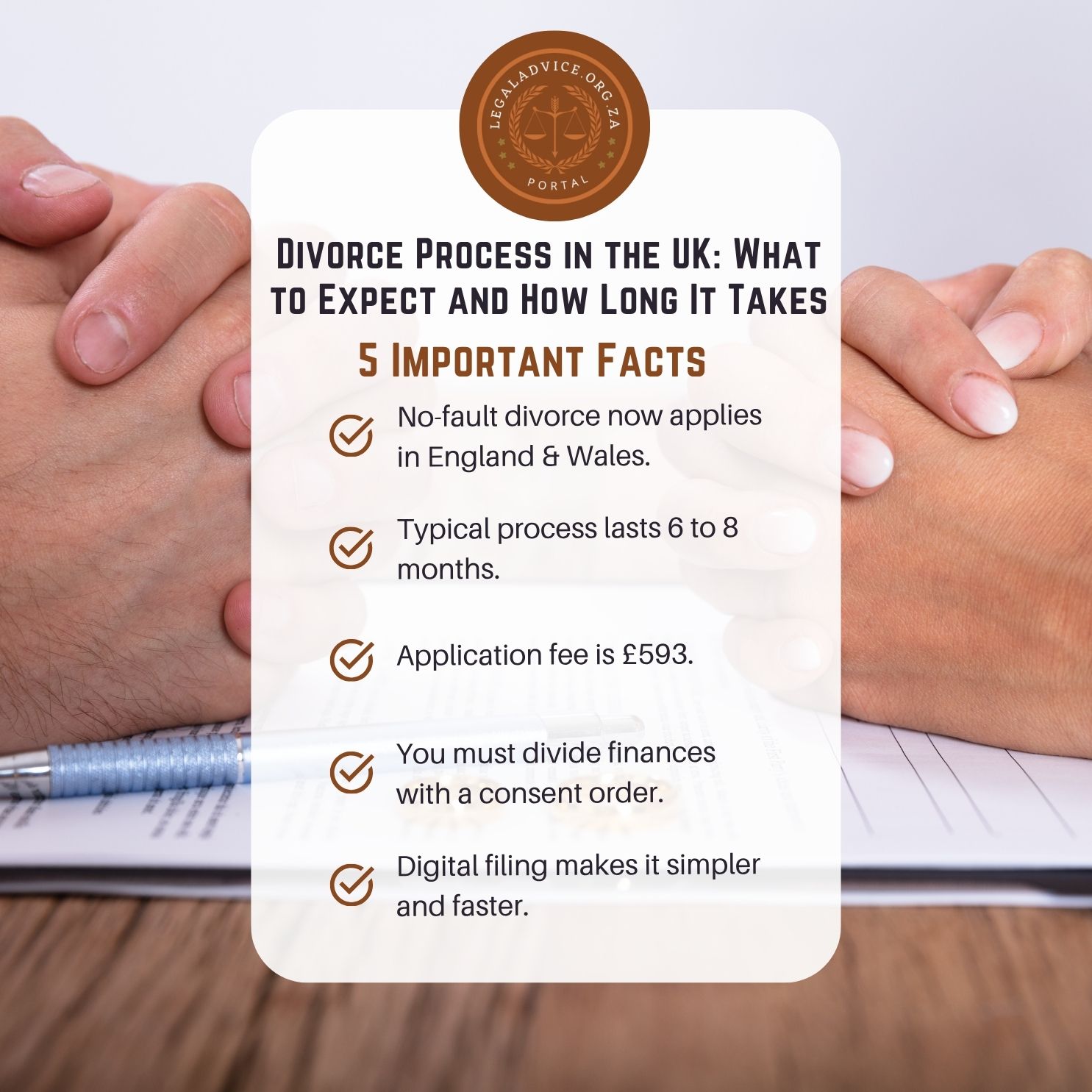
The divorce process in the UK is governed by the Divorce, Dissolution and Separation Act 2020, which came into effect in April 2022. This law simplified the procedure by introducing a no-fault divorce system. Under this system, couples no longer need to prove adultery or unreasonable behaviour to get divorced. Instead, one or both partners can simply state that the marriage has broken down irretrievably. This reform aimed to reduce conflict and make the divorce process in the UK more straightforward.
The first step in the divorce process is filing an application, which can be done online or through the post. If both parties agree, it is called a joint application. If only one applies, it is a sole application. The court issues an Acknowledgement of Service, which must be completed by the other spouse within 14 days. The second step is obtaining the Conditional Order, which confirms that the court sees no reason why the divorce cannot proceed. The third and final step is the Final Order, which legally ends the marriage.
Typically, the divorce process in the UK takes around six to eight months if there are no disputes. However, when financial or child-related issues arise, it can take much longer. Family courts prefer that couples reach agreements through mediation rather than lengthy litigation. The key institutions involved are the Family Court, HM Courts & Tribunals Service, and mediation providers accredited by the Family Mediation Council.
Step 1: Challenges During the Divorce Process in the UK
While the legal process seems simple, the reality can be far more complex. The first challenge many couples face during the divorce process in the UK is the emotional strain that affects decision-making. When communication breaks down, negotiations about money, property, or children can easily turn hostile. Mediation is encouraged to keep the focus on resolution rather than confrontation, but not all couples manage to reach agreement this way.
The second challenge is financial disclosure. Both partners must declare their income, assets, debts, and pensions fully. Hidden assets or incomplete disclosures can lead to disputes later. This step often requires professional legal or financial advice, which adds cost. The average legal fee for a straightforward divorce in the UK can range from £500 to £1,500 if uncontested, while contested divorces can cost several thousand pounds.
The third challenge involves child arrangements. Parents must agree on where the children will live and how time will be shared. When disagreements persist, the court can issue a Child Arrangements Order. This decision is always based on the best interests of the child. Delays in resolving such issues often extend the overall length of the divorce process in the UK.
Step 2: How Other Countries Handle Divorce
The divorce process in the UK differs significantly from how other countries approach marital dissolution. In South Africa, divorces are governed by the Divorce Act of 1979. While there is also a no-fault option, the system places strong emphasis on settlement agreements and the welfare of children. Mediation is common but usually happens before filing for divorce, rather than during the process.
In Australia, the Family Law Act 1975 sets out the divorce process. Like the UK, it also uses a no-fault system. The main requirement is that couples must be separated for at least 12 months before applying. This waiting period is intended to give couples time to reconsider reconciliation. The process itself is largely administrative and can be completed online, much like the UK’s digital system.
The United States, on the other hand, has a more fragmented structure. Each state has its own divorce laws, with varying waiting periods and grounds for dissolution. Some states allow for no-fault divorce, while others still require proof of wrongdoing. The length and cost of the process depend heavily on the state and the complexity of financial settlements. Compared to the UK, the US system tends to be slower and more expensive.
| Country | Governing Law | No-Fault Divorce | Average Duration | Main Focus |
|---|---|---|---|---|
| United Kingdom | Divorce, Dissolution and Separation Act 2020 | Yes | 6–8 months | Reduced conflict |
| South Africa | Divorce Act 1979 | Yes | 8–12 months | Child welfare |
| Australia | Family Law Act 1975 | Yes | 12 months (separation) | Reflection period |
| United States | State-specific laws | Varies | 6–24 months | Financial disclosure |
Step 3: Practical Steps to Manage the Divorce Process in the UK
If you are starting the divorce process in the UK, a few practical steps can help make the journey less stressful. The first step is preparation. Gather key documents early, including marriage certificates, bank statements, mortgage details, and pension information. This speeds up the disclosure process.
The second step is to seek advice before filing. Free legal guidance is available through Citizens Advice, and many solicitors offer fixed-fee consultations. Understanding your legal rights can prevent mistakes that lead to unnecessary delays. The third step is to consider mediation. Courts in England and Wales expect couples to attend a Mediation Information and Assessment Meeting (MIAM) before starting formal proceedings. Mediation often results in quicker and less costly settlements.
Finally, patience is essential. The divorce process in the UK follows a timeline for a reason. The minimum waiting period between the Conditional Order and Final Order is six weeks. This gap allows both sides to finalise financial and practical matters before the marriage ends legally. Rushing this stage can cause future complications.
| Step | Task | Timeframe | Benefit |
|---|---|---|---|
| 1 | File for divorce online or by post | Week 1 | Starts process officially |
| 2 | Acknowledge service | Within 14 days | Confirms response |
| 3 | Apply for Conditional Order | Around 20 weeks | Court review |
| 4 | Apply for Final Order | After 6-week waiting period | Legal end of marriage |
Reflecting on the Divorce Process in the UK
The divorce process in the UK is now one of the most streamlined systems in Europe, thanks to the introduction of no-fault divorce. While this change makes it less confrontational, it does not remove the emotional and financial strain that separation brings. Divorce is not simply a legal transaction but a life transition that requires empathy, organisation, and support. By understanding each stage and learning from how other countries manage similar challenges, individuals can navigate the divorce process in the UK with greater confidence and a stronger sense of control over their future.