

Contract disputes in the UK are one of the most common sources of business tension and personal stress. Whether it is a disagreement between a supplier and a client or between partners in a small business, contract issues can quickly escalate if not handled correctly. The good news is that not every disagreement has to end up in court. Understanding how to resolve contract disputes in the UK without going through lengthy litigation can save time, money, and relationships.
Before going into the details, here are the main points this article will explore:
- How contract disputes in the UK typically arise and what laws govern them
- The first practical steps to take when a dispute begins
- The alternative methods available to settle disputes without going to court
- How other countries, including South Africa and Australia, manage contract disagreements
- Tips for preventing contract disputes and protecting your business or personal agreements
@judithfiddler Breach of contract claims whilst still employed cant proceed so dont lodge them. #breachofcontract #employmentlaw #hruk #hr #dontgetthiswrong #unfairdismissal #resignation #termination #hrmindshift ♬ original sound – HR Mindshift
Understanding Contract Disputes in the UK
The first step to understanding contract disputes in the UK is knowing what a contract actually is. A contract is a legally binding agreement between two or more parties that creates mutual obligations. For a contract to be valid, it must include an offer, acceptance, consideration (something of value exchanged), and an intention to create legal relations.
Contract disputes in the UK often occur when one party believes the other has breached the agreement—by not performing their part, delivering poor-quality work, or missing payment deadlines. For instance, if a web design company fails to deliver a finished website by the agreed date, the client may claim breach of contract.
The main laws governing contract disputes in the UK are found in the Contracts (Rights of Third Parties) Act 1999 and the Consumer Rights Act 2015. These laws set out the rights of parties and the remedies available when things go wrong. The courts can award damages, specific performance (forcing one party to fulfil their obligations), or cancellation of the contract, but there are many ways to avoid court altogether.
Step 1: Identify the Nature of the Contract Dispute
The first thing to do when facing a contract dispute in the UK is to identify exactly what has gone wrong. Review the contract and check the specific terms related to the disagreement. Look at clauses covering deadlines, payment, quality standards, and termination. Make sure you have evidence to support your position—emails, invoices, or written communications are often key.
The second thing to do is to clarify whether the breach is major or minor. A major breach may allow you to terminate the contract entirely, while a minor one might only entitle you to compensation. For example, if a catering company provides a slightly smaller number of meals than promised but still delivers the event successfully, this may be a minor breach rather than grounds to cancel the entire agreement.
Understanding the scale and nature of the breach helps you choose the best approach to resolve the problem without court involvement.
Step 2: Try to Negotiate Before Taking Legal Action
The first step to resolving a contract dispute in the UK without court is negotiation. Contact the other party and explain the problem clearly but calmly. Focus on what solution would satisfy both sides—whether that is a payment adjustment, a replacement product, or an extended deadline. Keeping the discussion professional helps avoid escalation.
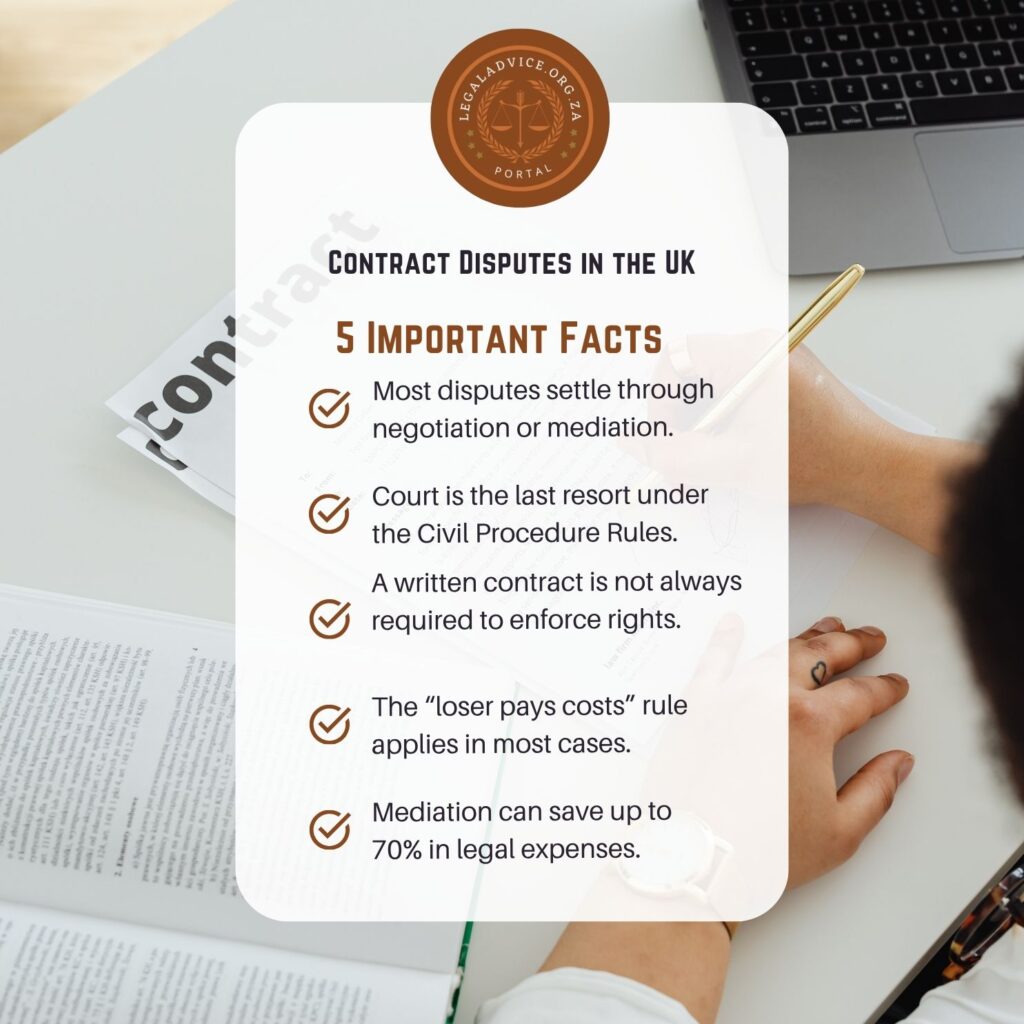
If direct negotiation fails, the second step is to use mediation. Mediation involves an independent third party who helps both sides reach an agreement. It is confidential, faster than court, and much cheaper. The Civil Mediation Council regulates professional mediators in the UK, and many law firms now recommend mediation before any court filing.
The third step is arbitration, a more formal process where an independent arbitrator listens to both sides and makes a binding decision. This is common in commercial contracts, especially those involving international partners. The Arbitration Act 1996 provides the legal framework for this process.
| Method | Who Oversees It | Cost | Binding? | Typical Timeframe |
|---|---|---|---|---|
| Negotiation | The parties themselves | Minimal | No | Days to weeks |
| Mediation | Civil Mediation Council or private mediator | Low to moderate | No | Weeks |
| Arbitration | Chartered Institute of Arbitrators | Moderate to high | Yes | Months |
These options show that contract disputes in the UK can often be resolved without expensive legal battles, saving both parties valuable time.
Step 3: Learn How Other Countries Handle Contract Disputes
When comparing contract disputes in the UK with systems elsewhere, several lessons emerge. In South Africa, mediation and arbitration are also strongly encouraged under the Arbitration Act 1965. Many businesses include mandatory arbitration clauses in their contracts to ensure faster resolution. The South African approach often focuses on restoring commercial relationships rather than assigning blame.
Australia uses a similar approach under its Commercial Arbitration Acts, which exist in each state. Disputes are first referred to mediation, and only if that fails do they proceed to arbitration or court. For example, an Australian construction company and supplier might use the Building and Construction Industry Security of Payment Act to resolve non-payment issues quickly through adjudication before considering court action.
In the United States, contract disputes are often resolved through binding arbitration because of widespread inclusion of arbitration clauses in business contracts. This has made arbitration a standard part of American commercial practice, though it has also raised questions about fairness in cases involving smaller businesses or consumers.
| Country | Main Legislation | Common Method | Court Alternative |
|---|---|---|---|
| United Kingdom | Arbitration Act 1996, Consumer Rights Act 2015 | Mediation and Arbitration | Yes |
| South Africa | Arbitration Act 1965 | Arbitration | Yes |
| Australia | Commercial Arbitration Acts | Mediation and Adjudication | Yes |
| United States | Federal Arbitration Act | Binding Arbitration | Yes |
This comparison highlights that the UK’s dispute resolution structure is well aligned with global best practices, though its flexibility gives parties more control over the process.
Step 4: Take Preventive Steps to Avoid Contract Disputes in the Future
The most effective way to handle contract disputes in the UK is to prevent them from happening in the first place. The first step is to draft clear, detailed contracts. Every agreement should spell out the scope of work, payment terms, deadlines, and what happens if either side fails to perform. Avoid vague terms such as “reasonable effort” or “mutual understanding,” which can lead to misunderstandings later.
The second step is to include a dispute resolution clause. This clause specifies how conflicts will be handled before court involvement, usually by mediation or arbitration. Many businesses now adopt these clauses as standard to save time and cost in the long run.
The third step is to keep written records of all communications. Verbal agreements are difficult to prove, while emails and letters create a clear paper trail. Regularly reviewing performance and maintaining good communication with clients or partners can prevent small problems from growing into serious disputes.
| Preventive Action | Purpose | Benefit |
|---|---|---|
| Clear contract terms | Defines obligations | Reduces ambiguity |
| Dispute resolution clause | Sets process before court | Saves time and cost |
| Record keeping | Provides evidence | Strengthens legal position |
These practical measures make it easier to manage professional relationships and reduce the risk of disputes escalating into legal battles.
Reflecting on Contract Disputes in the UK
Contract disputes in the UK do not have to end up in court. In most cases, a structured approach involving negotiation, mediation, or arbitration achieves a fair resolution while preserving business relationships. The UK’s flexible legal framework gives individuals and companies several routes to resolve issues efficiently. The key is to stay proactive, communicate clearly, and seek early advice before positions harden. In the end, understanding how to manage contract disputes in the UK without court is not just about avoiding conflict—it is about protecting your time, finances, and professional integrity.